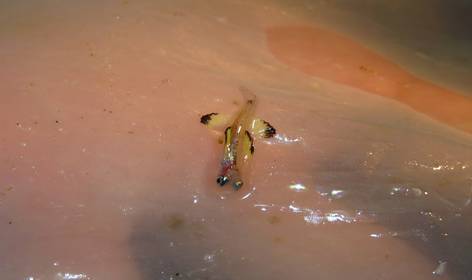


The Exocoetidae is an oceanodromous fish, which inhabits open water areas or the shallow surface area of flowing tides. The swimming ability of the larva is poorer than the adult fish and the larva only drifts along with tides. After growing up, the larva becomes agile and has rather fast swift actions in order to escape the predator’s attack. If the larva is frightened, it would use the specialized pectoral fins along with its pelvic and caudal fins to flip out above the water and glide over it for a long distance. The larva’s fins all cooperate together while gliding, for example, the caudal fin is the power source to push the larva moving forward, and the pectoral and pelvic fins help the larva maintain balance and float in the air. The longest flying distance can be up to 400m, therefore this type of fish is called a“flying fish”. The Exocoetidae mainly feeds on plankton such as crustacean larva. In addition, the egg mass laid by the Exocoetidae is adhesive, so the egg mass is able to adhere to the drifting objects or algae.
The reason it is called “Hirundichthys” is because of its slender somatotype. Currently there are three types of Hirundichthys in Taiwan that are on the record, i.e. Hirundichthys oxycephalus, H. rondeletii, and H. speculiger, respectively. They are primarily distributed within a depth of 20m or shallower water areas along the east coast of Taiwan. The swimming ability of Hirundichthys larva is poor, so there is a chance for us to find the larva in the slow flow area on the shore.
The larva of the Exocoetidae plays an important role in the pelagic ecosystem because it is the prey for various larger pelagic predatory fish.Consequently, the migration pattern of the larva often has a direct impact on the ingestion and migration tracks of larger fish.
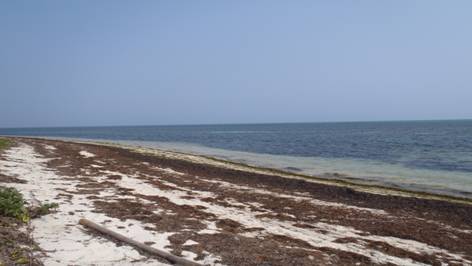
The sample collected along the North coast of Dongsha Atoll National Park waters was the 1st Exocoetidae data on the record. Dongsha Atoll National Park not only has a unique atoll landscape, but also bears an abundant diversity of fish. The steep continental slope outside of the atoll directly connects to the inhabitation area of the pelagic fish, which also creates a precious ecological environment. As to the question regarding how many more Exocoetidae family inhabit the Dongsha Atoll National Park waters, further surveys are required to reveal the whole puzzle. (Written by LIAO, CHEN-HENG)