


In July 2014, the Dongsha Island coast guards found a unique looking fish that was injured and floating helplessly near the coast. The Marine National Park Headquarters (MNPH) was contacted and MNPH personnel were dispatched to bring the fish back to the Dongsha Island wildlife conservation center so that it could be nursed back to health. Despite these efforts, the fish eventually died of its wounds. Inspections by MNPH researchers verified the fish as the Comet (Calloplesiops altivelis Steindachner, 1903), a newly recorded fish species at Dongsha Atoll National Park。
The Comet belongs to the Calloplesiops genus of the Plesiopidae family. It is a small noctural reef fish that can reach up to 20 cm in length. It lives in heavily perforated reef walls or underneath reef ledges. The Comet mainly feeds on small arthropods, fish, and polychaetes. The Comet has a flat body, large scales, retractable mouth, and dorsal and anal fins that extend towards the back. The tip of the tail fin tapers to a fine tip, and there is an eye spot on the last three rays of the dorsal fin. The body of the Comet is brownish black, speckled with many small, pale-blue spots that appear like scattered pearls (the Chinese name of the Comet is the Pearl Calloplesiops)。
The Comet tends to hide in cracks between coral rocks during the day and can be rather difficult to find. When frightened, the Comet hides the front end of its body into a crevice and extend its dorsal, anal, and tail fins to form a cohesive shape. With the help of the eye spot on the dorsal fin, the Comet would mimic a moray eel looking out from its resting hole and intimidate potential predators. Fish of the Plesiopidae family tend to be nocturnal. They are hard to track and have been long regarded as mysterious and enigmatic due to their bright colors, thus making them popular as a marine aquarium fish. As of today, this sample collected from the Dongsha Atoll National Park would be the third species of the Plesiopidae family after the crimsontip longtip (Plesiops coeruleolineatus) and sharp-nosed longfin (Plesiops oxycephalus) recorded at Dongsha. The Dongsha Atoll National Park has a rich coral ecology and a diverse selection of fish species. Further investigation would be required in order to find out the exact number of the Plesiopidae family that inhabits this area. (Text / Liao Zhen heng, Dongsha Station researcher)
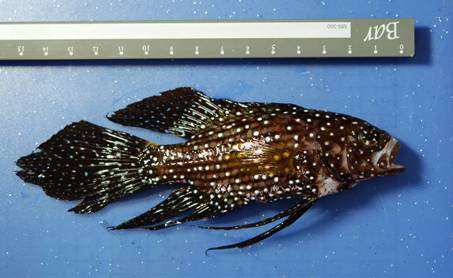
The Comet (C. altivelis), a new fish species recorded at Dongsha with unique mimicry abilities. (Photographed by Yang Shao-min)
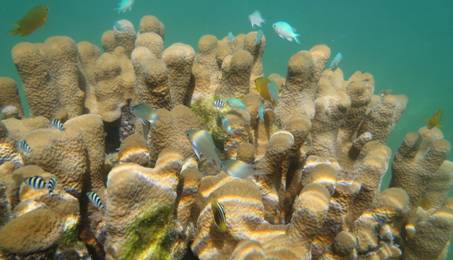
The east coast of Dongsha Island has an intact coral reef ecology home to a rich diversity of species. (Photograhed by Liao Zhen-heng)