


Beneath the shimmering waters of Dongsha’s seagrass beds, within the fine white sand, many organisms hide and move between the sand and seagrass. While wandering through this habitat, one may suddenly encounter what appears to be a peculiar work of art—stacked layers of thin sand sheets forming a “sand bowl.” More vividly described, it looks like a rolled tea strainer made of sand grains. These thin layers of sand overlap in graceful curves; some consist of only a single layer, others of six or seven, all with a uniform arc as if pressed by a machine. Is this the creation of some organism, or a man-made object? A closer look reveals that many of these structures are scattered across the sandy bottom of the seagrass beds. What exactly are they?
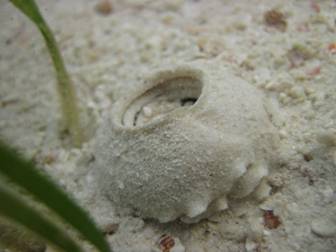 |
| A tea strainer made of sand grains (Photo provided by Prof. Yu-Wen Chiu) |
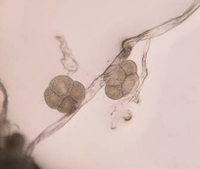
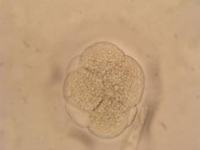
Under continuous microscopic observation, it was discovered that these thin sheets are composed almost entirely of sand grains. The grains seem glued together. Carefully separating them reveals developing embryos nestled between the grains. Confirmation showed that this structure is actually a mass of fertilized eggs. The eggs are connected by egg capsule threads and adhere to sand grains, forming thin, slightly curved sand sheets about 1–2 cm in size. Naturally, these sheets curl into the shape of a sand funnel. In other words, this “sand tea strainer” is truly an egg mass. Further observation reveals stages of development: the 8-cell stage, the 16-cell stage, following the pattern of spiral cleavage; then the trochophore larval stage; and finally the veliger stage. Inside the egg membrane, the larvae spin playfully, bearing a tiny shell on their backs and waving cilia atop their velum. At this point, it becomes clear that these are snail embryos. But which species of snail mixes its eggs with sand and rolls them into spirals?
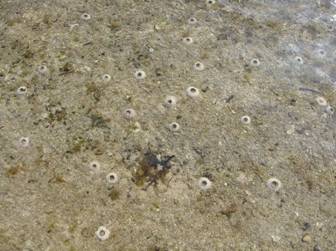 |
| Sand funnels scattered across the seagrass bed (Photo provided by Prof. Yu-Wen Chiu) |
 |
 |
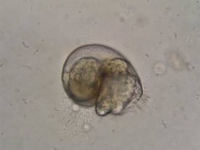 |
| Cleaving eggs connected by capsule threads | 8-cell stage cleavage | Spinning veliger larva |
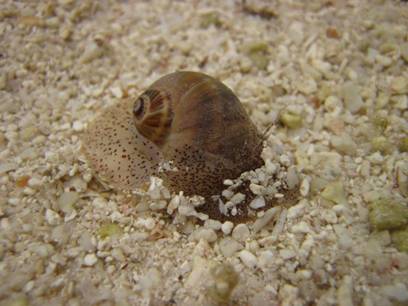
Returning to the shore for further observation revealed the answer. The mother of this egg mass is the small moon snail commonly found in Dongsha’s seagrass beds, Natica gualteriana Récluz, 1844. This species inhabits sandy-muddy intertidal flats and usually buries itself halfway in the sand, crawling with its broad muscular foot. During egg-laying, fertilized eggs are transported through the oviduct to the genital pore. Unlike some snails that release eggs directly into the water, the moon snail uses ciliated grooves near its head-foot region to convey the eggs onto the surface of its foot. Muscular movements and cilia then mix the fertilized eggs with mucus secreted from the egg capsule gland and surrounding sand grains. This sand–egg mixture is spread onto the outer surface of the shell and pushed along its curved contour. Upon contact with seawater, the capsule secretion gradually hardens, forming a ribbon-like, bowl-shaped overlapping egg mass—commonly called a “sand bowl.” This structure serves as the cradle of moon snail offspring. The curvature of the “slightly curved sand sheets” mentioned earlier reflects the contour of the mother snail’s shell. In Dongsha’s seagrass beds, another species, the brown-banded moon snail, exhibits the same behavior. Each egg capsule may contain an estimated 100,000 eggs.
 |
|
Small moon snail in Dongsha seagrass bed (Photo provided by Prof. Yu-Wen Chiu) |
Why does the mother moon snail mix her fertilized eggs with sand? The reason is that sand-coated egg masses are less likely to be preyed upon by predators. This allows the developing snails to grow safely within their sandy cradle. When the larvae reach their final stage, they break free from the egg membrane, and the capsule threads gradually decompose. Eventually, the entire sand funnel structure disintegrates. Interestingly, different moon snail species use sand from their specific habitats to construct their egg masses. For example, in the Qigu Lagoon of Taijiang National Park, small moon snails produce black egg masses using dark sand, while those in the lagoon of Dongsha Atoll National Park produce golden egg masses from fine coral sand.
Author: Assistant Professor Yu-Wen Chiu, Department of Biomedical Science and Environmental Biology, Kaohsiung Medical University (Project Leader of the 2012 “Survey of Intertidal to Terrestrial Mollusk Resources in Dongsha” commissioned by the Marine National Park Headquarters).