


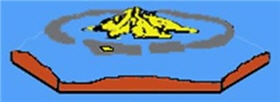
 {{body}}nbsp;According to Darwin’s theory of coral reef formation, the early development of an atoll may begin around a volcanic island formed by submarine volcanic eruptions. Corals attach and grow along the shoreline, forming a fringing reef. As the island gradually subsides, coral reefs continue to accumulate and grow upward. Because water exchange is better along the outer margin of the island, coral growth there is more vigorous than on the inner side. Over time, a barrier reef forms. Eventually, the volcanic island completely sinks beneath the sea surface, leaving only a ring-shaped coral reef near the surface that continues to grow—thus forming an atoll.
In general, the formation process of Dongsha Atoll is similar to the sequence described above. However, unlike the classic model, Dongsha Atoll did not develop on a volcanic foundation. Studies of coral reef groups in southwestern Taiwan suggest that the early reefs of Dongsha likely developed upon shallow-water cold seep carbonates. During the sea-level drops of the Tertiary and Quaternary glacial periods, these cold seep carbonates provided an optimal substrate for shallow-water coral reef development. Later, due to seafloor spreading and subsidence in the South China Sea, combined with gradual sea-level rise, the cold seep carbonates were progressively submerged. Meanwhile, Dongsha’s coral reefs continued to grow under favorable environmental conditions, eventually forming a structurally complete atoll. In contrast, other reef platforms such as Beiyu Shoal, Nanyu Shoal, and the Zhongsha Islands subsided below sea level because coral growth rates there were much slower than the rate of sea-level change.