


Dongsha Atoll is the only well-developed atoll in Taiwan. Within the marine ecological zone of Dongsha Island, the most distinctive feature is its extensive seagrass bed ecosystem, which harbors nearly 150 species of mollusks from 57 families. The banded volvatella, belonging to the subclass Opisthobranchia and order Sacoglossa, was recorded as a new family, genus, and species for Taiwan in 2006. In 2011, through the efforts of Professor Yu-Wen Chiu’s research team at Kaohsiung Medical University, it was also discovered in Dongsha. Volvatella vigourouxi has been recorded in Amami-Oshima and the Okinawa Islands of Japan, Taiwan, and New Caledonia off eastern Australia. It is widely distributed in tropical and temperate waters of the Pacific and western Indo-Pacific. (Photo: Volvatella vigourouxi, provided by Professor Yu-Wen Chiu, Kaohsiung Medical University)
Mollusks serve as primary consumers, predators, and detritivores within food webs, playing an important role in energy transfer in ecosystems. The banded volvatella is a small mollusk with a thin, slightly translucent shell. Its body is swollen and shaped like an oval or pear. It mainly inhabits algae in the intertidal zone and can be found living among green algae of the genus Caulerpa, feeding by sucking out the cytoplasmic contents of algal cells. Literature indicates that sacoglossan species can transform chemical compounds obtained from algae into their own chemical defense mechanisms. Shelled sacoglossans such as Volvatella vigourouxi, when feeding on Caulerpa, are able to biotransform toxic substances contained within the algae to deter or suppress predation and attacks from predators. Therefore, when stimulated or threatened, the white mucus secreted by the banded volvatella may consist of chemical compounds derived from metabolized algal toxins.
Mollusks serve as primary consumers, predators, and detritivores within food webs, playing an important role in energy transfer in ecosystems. The banded volvatella is a small mollusk with a thin, slightly translucent shell. Its body is swollen and shaped like an oval or pear. It mainly inhabits algae in the intertidal zone and can be found living among green algae of the genus Caulerpa, feeding by sucking out the cytoplasmic contents of algal cells. Literature indicates that sacoglossan species can transform chemical compounds obtained from algae into their own chemical defense mechanisms. Shelled sacoglossans such as Volvatella vigourouxi, when feeding on Caulerpa, are able to biotransform toxic substances contained within the algae to deter or suppress predation and attacks from predators. Therefore, when stimulated or threatened, the white mucus secreted by the banded volvatella may consist of chemical compounds derived from metabolized algal toxins.
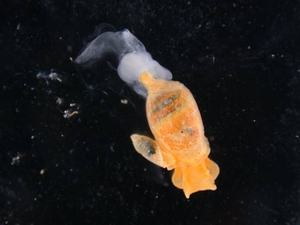
When stimulated, the banded volvatella ejects white mucus from a tubular siphon-like structure at its posterior end (Photo provided by Professor Yu-Wen Chiu, Kaohsiung Medical University)
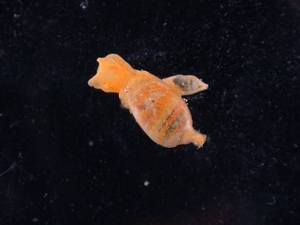
The hermaphroditic banded volvatella practices cross-fertilization. During mating, the smaller “male” individual climbs onto the shell of the larger “female” individual to copulate.
(Photo provided by Professor Yu-Wen Chiu, Kaohsiung Medical University)