


In July 2014, a researcher from the Marine National Park Headquarters (hereinafter referred to as MNPH) discovered three peculiar-looking gobies in an extremely shallow seagrass sandy area at the western lagoon mouth of Dongsha Island while conducting a conservation patrol. Based on on-site observation of their caudal and pectoral fins, the fish were initially identified as belonging to the genus Callogobius. After being collected and examined in the laboratory, they were confirmed as a new record species for Dongsha Atoll National Park—the Hasselt’s Goby (Callogobius hasseltii Bleeker, 1851).
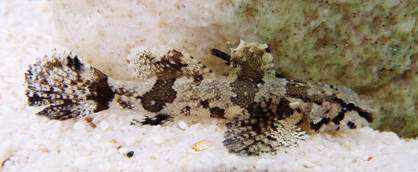
Hasselt’s Goby belongs to the family Gobiidae and the genus Callogobius. It is a small, warm-water, benthic fish species with a maximum length of only 7.3 cm. It is commonly found in coral reef habitats or shallow waters with mixed reef-sand substrates, feeding mainly on small crustaceans and polychaete worms. Its body is covered with regular dark brown camouflage-like oblique stripes, and the upper half of the caudal fin bears a brown circular spot—an important feature distinguishing it from other species in the same genus. Compared to most gobies, Hasselt’s Goby has relatively poor swimming ability. When moving, it slowly sways its pectoral and caudal fins, resembling drifting seagrass or algae in the water. Its cryptic coloration and posture provide strong camouflage, allowing this slow-moving species to remain exposed in shallow waters without easily being detected by predators such as birds.
In Taiwan, previous records of Hasselt’s Goby were limited to the waters around Green Island. The specimen collected from the western coast of Dongsha Island represents the second recorded occurrence in Taiwan and the fifth species of the genus Callogobius documented in Dongsha Atoll National Park. The collection site was a sandy, extremely shallow area (approximately 5 cm deep) with very poor water exchange. After prolonged sun exposure, water temperatures reached as high as 38°C. Despite the near absence of other fish species in such harsh conditions, Hasselt’s Goby was still observed swimming leisurely, demonstrating the remarkable resilience of intertidal organisms in Dongsha Atoll National Park. (Text by Liao Chen-heng, Dongsha Management Station, MNPH)
|
|
|
The well-camouflaged Hasselt’s Goby (C. hasseltii). (Photo by Liao Chen-heng) |
|
|
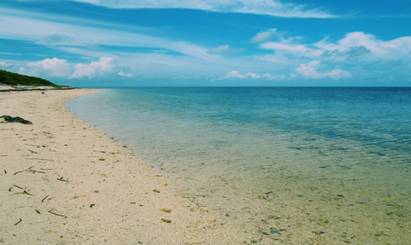
| The shallow intertidal waters along the western and northern coasts of Dongsha Island are filled with drifting seagrass and algal debris, providing excellent shelter for many small animals. (Photo by Liao Chen-heng) |
Dongsha Management Station (including Research Station)