


 |
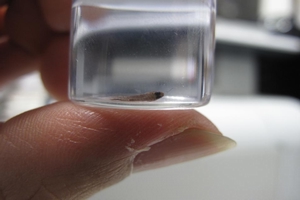 |
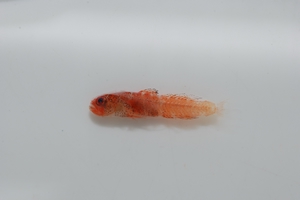
| Trimmatom nanus, adult body length approximately 10 mm (Photo by Chen Yi-Hsiung) | Actual size of a Trimmatom nanus specimen (Photo by Chen Yi-Hsiung) |
Fact Sheet:
Trimmatom nanus (Winterbottom & Emery, 1981) is an omnivorous, small coral reef benthic fish. Taxonomically, it belongs to the class Actinopterygii, order Perciformes, and family Gobiidae. It is a rare but not endangered species. The species is mainly distributed in the western Indian Ocean and the central to western Pacific Ocean, inhabiting crevices along reef slopes and trench walls. It was first discovered in the Indian Ocean. According to current literature, it has been recorded in Australia, the Chagos Islands, Indonesia, the Maldives, New Caledonia, Papua New Guinea, and Tonga. There have been no records from Taiwan’s main island to date; the specimen collected from the outer Dongsha Atoll represents the first record for Taiwan.
Trimmatom nanus typically inhabits coral reef areas at depths of 5–30 meters (optimal depth 20–30 m). It can tolerate water temperatures ranging from approximately 17.99–33.14°C (optimal range 25.22–28.94°C) and salinity levels between 33.04–36.52 psu. The body is semi-transparent with an orange hue, featuring 12 dark orange vertical bands along the sides. Dark brown pigment spots are scattered on the pre-anal body region and on the membranes of the dorsal and anal fins. It has two dorsal fins; the caudal fin is nearly straight with only a slight notch. Body depth is about 16.4% of total length (TL). The eyes are large, with eye diameter approximately 42.4% of head length (HL).
Although Trimmatom nanus is recognized as “the world’s smallest coral reef benthic fish,” it ranks second among the world’s smallest fish species overall. The smallest known fish is Paedocypris progenetica, a freshwater cyprinid species discovered in swamp areas of Sumatra, Indonesia, with adults measuring only 7.9 mm in length. Nevertheless, the discovery of this diminutive species in the waters of Dongsha Atoll is a remarkable finding.
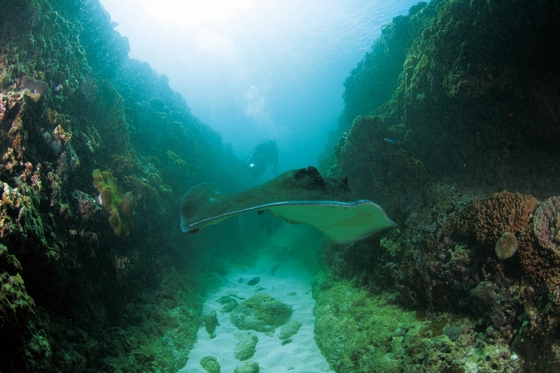
The trench topography of the outer Dongsha Atoll provides excellent refuge for marine organisms (Photo courtesy of the Marine National Park Headquarters)