

At noon, the blazing sun shines upon the fine coral sands of Dongsha. Walking along the beach, one can feel the relentless energy of sunlight pouring down onto the earth’s surface. This light and heat provide the driving force for photosynthesis in the adjacent seagrass beds beneath the sand.
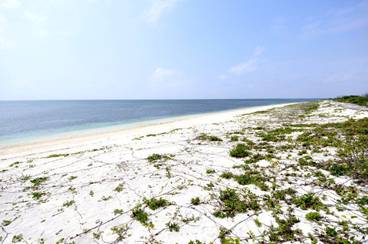
Dongsha beach covered with coral sand (Photo by Yen-Ming Huang)
Seagrass beds are distributed in temperate and tropical seas, occurring in intertidal and subtidal soft-bottom habitats. They are often found alongside coral reef and mangrove ecosystems. In addition to providing high primary productivity and complex habitats, seagrass beds also possess considerable carbon storage capacity in the ocean. The organic carbon fixed by seagrass contributes significantly to marine food webs, sustaining many benthic and planktonic organisms. More than half of marine animal species utilize carbon fixed by seagrass. Many fish and shellfish are attracted to seagrass habitats, where they find both food and shelter. A closer look at the seagrass in Dongsha Lagoon reveals that it differs from algae: seagrass has vascular bundles, and when bent, one can feel fibrous tissue inside—something algae do not possess.
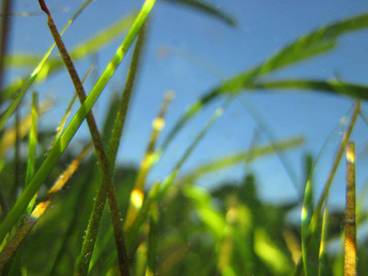
Seagrass is a vascular plant (Photo by Chun-Yu Su)
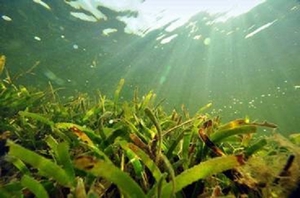
Diving beneath the surface into the seagrass bed, one can see small fish, shrimp, and crabs curiously observing you among the blades. Various snails and sea slugs crawl along the leaves, while sea anemones attach themselves to them. Beneath the underground rhizomes of seagrass lies an astonishing diversity of benthic organisms, including polychaete worms, mollusks, and sea cucumbers. Some of these organisms are merely passing through to feed; some reside in nearby coral reefs and enter the seagrass bed to forage; others are long-term residents whose entire lives—from feeding and shelter to reproduction—are spent within this habitat. Together, these residents and visitors form a highly biodiverse ecosystem.
 |
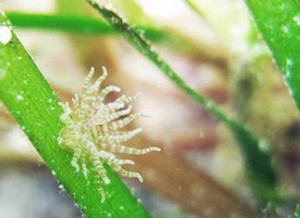 |
| Seagrass beds provide food and shelter for organisms (Photo by Yen-Ming Huang) | Sea anemones attached to seagrass leaves (Photo by Chun-Yu Su) |
Why are seagrass beds so productive? Do all these organisms eat seagrass? Not exactly. Remember that seagrass contains cellulose. Organisms that feed directly on it must possess well-developed mouthparts capable of tearing seagrass and digestive enzymes capable of breaking down cellulose. Besides certain fish and sea urchins with strong mouthparts that can bite or tear seagrass, among mollusks the most successful examples are species of nerite snails, such as the emerald nerite and the lightning nerite. Their specialized radulae have well-developed lateral teeth that scrape away the fibrous epidermis of seagrass, and marginal teeth that graze on the plant tissue.
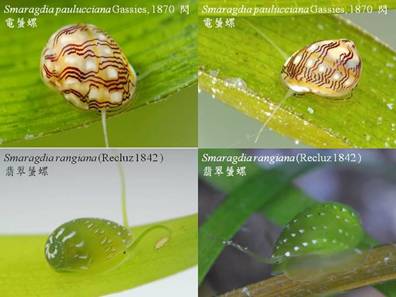
Emerald nerite and lightning nerite (Photo by Yu-Wen Chiu)
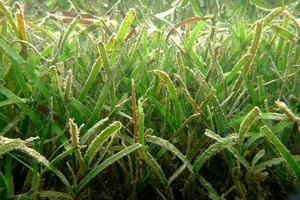
As the saying goes, “Where there is grass, there is dew; nature always provides a way.” Some organisms feed on the epiphytic algae growing on seagrass leaves. For example, certain sea hares have evolved leaf-like camouflage resembling seagrass blades. Others feed on detritus formed from aging and fallen seagrass leaves. Additionally, some parasitic organisms, such as certain cowries, live on other host species. With these primary consumers in place, predators follow. A common predator in seagrass beds is the small moon snail, an active hunter that envelops buried bivalves or other snails with its foot, drills a hole in the prey’s shell using its radula, and extends its proboscis to scrape out the flesh.
Seagrass beds not only provide excellent habitats and abundant food for marine organisms, but sunlight energizes their vitality. The organisms here are all actors on a stage, influencing and interacting with one another, together performing the ongoing drama of life and evolution within the seagrass ecosystem.
 |
 |
| Epiphytic algae on seagrass leaves provide an important food source (Photo by Yen-Ming Huang) |
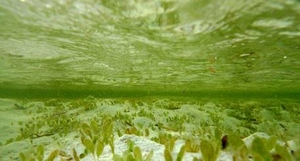
Seafloor of Halophila ovalis (Photo by Yen-Ming Huang) |
Author: Assistant Professor Yu-Wen Chiu, Department of Biomedical Science and Environmental Biology, Kaohsiung Medical University (Project Leader of the 2012 “Survey of Intertidal to Terrestrial Mollusk Resources in Dongsha” commissioned by the Marine National Park Headquarters).