


When immersed in the underwater world, one of the most exciting experiences is interacting with marine life. Damselfish are among the creatures divers most enjoy encountering. In this large family, the most famous is undoubtedly the clownfish. Thanks to the movie “Finding Nemo,” its image is deeply imprinted in people’s minds. As a result, when divers encounter a clownfish in the sea, they often let out an excited exclamation—even if it means accidentally swallowing a mouthful of seawater while biting on their regulator.
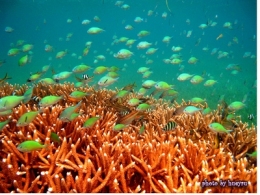
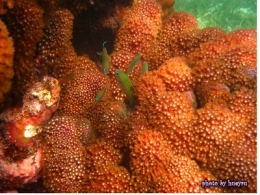
The blue-green chromis (Chromis viridis) is another star that often draws admiration. These fish prefer to form schools above branching corals, typically in groups ranging from dozens to hundreds of individuals. Together they feed on plankton in the water column. When danger approaches, they swiftly dart into the gaps among coral branches for shelter. As light refracts through the water, their bodies shimmer in hues shifting from bright turquoise to pale blue. Especially when threatened, their synchronized movement—flashing as one into the coral branches—compels passersby to pause and admire their graceful “dance.”
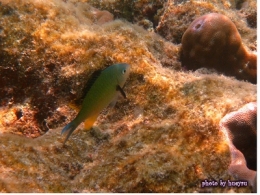
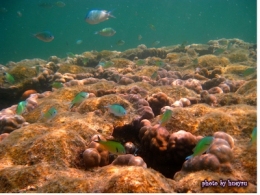
Although blue-green chromis generally inhabit depths of 10–12 meters, around Dongsha Island they can easily be observed in shallow waters less than 2 meters deep, where they are also abundant. Large schools of several hundred individuals are commonly seen. During the breeding season, male blue-green chromis display a distinct nuptial coloration: their body color gradually changes from turquoise to yellow, while the dorsal, caudal, and pectoral fins turn black. At this time, males clear nearby reef surfaces to prepare nesting sites for females to lay eggs. It is common during the breeding season to see groups of mature males gathered over reef patches, constantly cleaning the substrate, chasing rivals to defend their nests, and displaying to females swimming above in hopes of attracting them to spawn. After spawning, the male guards the eggs adhered to the reef surface, fanning them continuously to provide oxygen, removing dead eggs, and driving away potential predators. After about three days, the larvae hatch and begin their planktonic life. Only after developing sufficient swimming ability do they settle and seek a suitable habitat of their own. (Text and photos by Chen Hui-ju, Technician, Dongsha Management Station)
 |
 |
 |
 |