


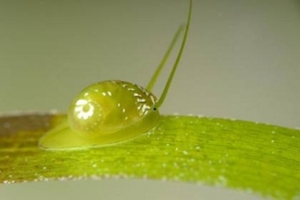
Dongsha Atoll National Park possesses the largest seagrass beds in Taiwan. These vast seagrass meadows provide the ideal habitat for the emerald nerite snail. Its small shell, adorned with emerald-green coloration dotted with white stripes, resembles a translucent green gemstone and serves as natural camouflage. The blades of seagrass not only create a complex three-dimensional habitat and shelter but also provide an abundant food source.
In the past, emerald nerite snails could be found in the intertidal zones of Green Island, Haikou in Pingtung, and along Taiwan’s western coast. As this species lives and reproduces entirely on seagrass, its population has gradually declined due to coastal development and habitat destruction. The discovery of this species in Dongsha not only reflects the biodiversity of Dongsha Atoll National Park but also preserves valuable genetic resources of the emerald nerite in Taiwan. Seagrass is the primary producer in the waters surrounding Dongsha. In addition to stabilizing sandy substrates, it serves as a nursery ground for juvenile fish, shrimp, and shellfish. The seagrass beds within Dongsha Atoll National Park are the largest in Taiwan, covering approximately 1,185 hectares. Protected seagrass habitats not only safeguard a complete habitat for the emerald nerite snail but also sustain many other marine organisms.
Measuring only about 0.5 centimeters in size, the emerald nerite snail displays a beautiful jade-green hue. Its green shell with white markings provides excellent camouflage among seagrass. The structurally diverse seagrass environment offers optimal space for movement and shelter, as well as abundant food resources. According to Assistant Professor Chiu Yu-wen from the Department of Biomedical Science and Environmental Biology at Kaohsiung Medical University, who previously conducted biodiversity surveys in Dongsha, emerald nerite snails, like other nerite species, are dioecious (separate sexes). Females lay transparent egg capsules on seagrass leaves. After hatching, the larvae drift with ocean currents until they find seagrass on which to settle and grow, continuing their life cycle.
Dongsha’s lush and gently swaying seagrass beds are not only the largest in Taiwan but also remarkable for their species diversity among the islands of the South China Sea. In addition to providing habitat for mollusks such as the emerald nerite snail, they nurture numerous fish and invertebrates, making them valuable resources for marine ecology and environmental education. For more information, please visit the Ecological Conservation section of this website.
In the past, emerald nerite snails could be found in the intertidal zones of Green Island, Haikou in Pingtung, and along Taiwan’s western coast. As this species lives and reproduces entirely on seagrass, its population has gradually declined due to coastal development and habitat destruction. The discovery of this species in Dongsha not only reflects the biodiversity of Dongsha Atoll National Park but also preserves valuable genetic resources of the emerald nerite in Taiwan. Seagrass is the primary producer in the waters surrounding Dongsha. In addition to stabilizing sandy substrates, it serves as a nursery ground for juvenile fish, shrimp, and shellfish. The seagrass beds within Dongsha Atoll National Park are the largest in Taiwan, covering approximately 1,185 hectares. Protected seagrass habitats not only safeguard a complete habitat for the emerald nerite snail but also sustain many other marine organisms.
Measuring only about 0.5 centimeters in size, the emerald nerite snail displays a beautiful jade-green hue. Its green shell with white markings provides excellent camouflage among seagrass. The structurally diverse seagrass environment offers optimal space for movement and shelter, as well as abundant food resources. According to Assistant Professor Chiu Yu-wen from the Department of Biomedical Science and Environmental Biology at Kaohsiung Medical University, who previously conducted biodiversity surveys in Dongsha, emerald nerite snails, like other nerite species, are dioecious (separate sexes). Females lay transparent egg capsules on seagrass leaves. After hatching, the larvae drift with ocean currents until they find seagrass on which to settle and grow, continuing their life cycle.
Dongsha’s lush and gently swaying seagrass beds are not only the largest in Taiwan but also remarkable for their species diversity among the islands of the South China Sea. In addition to providing habitat for mollusks such as the emerald nerite snail, they nurture numerous fish and invertebrates, making them valuable resources for marine ecology and environmental education. For more information, please visit the Ecological Conservation section of this website.
 |
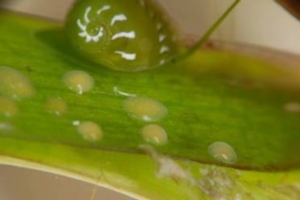 |
| Figure: The emerald nerite snail – a green gem on seagrass / Photo by Wang Hsiu-min | Figure: Transparent jelly-like egg capsules of the emerald nerite snail / Photo by Wang Hsiu-min |