


The Marine National Park Headquarters (hereinafter referred to as the Marine Headquarters) and the Kaohsiung Wild Bird Society (hereinafter referred to as KWBS) collaborated in 2010 and 2011 to conduct ecological monitoring and banding research on migratory birds passing through Dongsha Island. Over the two-year survey period, a total of 257 bird species were recorded on Dongsha Island—accounting for 43% of Taiwan’s 601 recorded bird species. Dongsha Island covers only about 1.74 square kilometers, less than one twenty-thousandth of Taiwan’s land area. Yet such a small island supports such a high density of bird species—truly a remarkable “Dongsha miracle”!
Dongsha Island lies at the northern end of the South China Sea and is the only island and reef in the region that remains above sea level year-round. Although small in size, it is located along the East Asian–Australasian Flyway and contains diverse habitats including woodland, sandy beaches, and lagoons. Like an oasis in the desert, it provides migratory birds traveling north and south with opportunities to rest, forage, and drink, replenishing their energy during long journeys. Consequently, the bird community of Dongsha Island is composed primarily of migratory species. The most abundant and diverse bird life occurs during the migration seasons of April–May and September–October.
Most bird species on Dongsha Island appear during migration periods, characterized by high species diversity but low individual numbers—a typical migratory pattern. Currently, only the White-breasted Waterhen has been recorded breeding on the island, with chicks documented. The ecological habits of birds here differ greatly from those on Taiwan’s main island. Some resident birds common in Taiwan, such as the Red Collared Dove, Black Drongo, Light-vented Bulbul, and Japanese White-eye, are recorded only as passage migrants or winter visitors on Dongsha Island. Conversely, species such as the Asian Koel, Lesser Coucal, House Swift, Grey Nightjar, Daurian Starling, and Hair-crested Drongo—rare or uncommon in Taiwan—have stable migratory populations on Dongsha. The Black-faced Spoonbill, which migrates between Northeast and Southeast Asia and mainly winters at the Zengwen River estuary in Tainan, has also been observed visiting Dongsha Island, enjoying the winter sunshine in the lagoon waters.
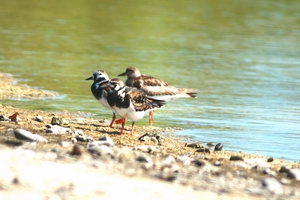
The survey team also conducted bird banding research. Captured shorebirds were fitted with leg flags representing Dongsha Island and then released. Visual records of these leg flags help track migration patterns. Observations show that Ruddy Turnstones previously banded on Dongsha return to the island in subsequent years. A Red-necked Stint banded on Dongsha was later sighted in Australia. In addition, shorebirds banded in northwestern Australia, southeastern Australia, southern Australia, New Zealand’s North Island, Alaska, and Chongming Island in mainland China have been recorded on Dongsha. These findings confirm Dongsha Island’s important role along the East Asian migratory flyway.
Birds are an important ecological resource and characteristic feature of Dongsha Atoll National Park. The Marine Headquarters and KWBS signed a “Cooperative Agreement on Avian Ecological Conservation” in 2010 to jointly implement the “Ecological Monitoring and Banding Survey of Migratory Birds on Dongsha Island.” Each spring and autumn, ecological surveys and banding activities are conducted on the island. Through long-term monitoring, the project aims to better understand the relationship between bird species and their habitats on Dongsha Island, thereby creating a more bird-friendly ecological environment.
Dongsha Island lies at the northern end of the South China Sea and is the only island and reef in the region that remains above sea level year-round. Although small in size, it is located along the East Asian–Australasian Flyway and contains diverse habitats including woodland, sandy beaches, and lagoons. Like an oasis in the desert, it provides migratory birds traveling north and south with opportunities to rest, forage, and drink, replenishing their energy during long journeys. Consequently, the bird community of Dongsha Island is composed primarily of migratory species. The most abundant and diverse bird life occurs during the migration seasons of April–May and September–October.
Most bird species on Dongsha Island appear during migration periods, characterized by high species diversity but low individual numbers—a typical migratory pattern. Currently, only the White-breasted Waterhen has been recorded breeding on the island, with chicks documented. The ecological habits of birds here differ greatly from those on Taiwan’s main island. Some resident birds common in Taiwan, such as the Red Collared Dove, Black Drongo, Light-vented Bulbul, and Japanese White-eye, are recorded only as passage migrants or winter visitors on Dongsha Island. Conversely, species such as the Asian Koel, Lesser Coucal, House Swift, Grey Nightjar, Daurian Starling, and Hair-crested Drongo—rare or uncommon in Taiwan—have stable migratory populations on Dongsha. The Black-faced Spoonbill, which migrates between Northeast and Southeast Asia and mainly winters at the Zengwen River estuary in Tainan, has also been observed visiting Dongsha Island, enjoying the winter sunshine in the lagoon waters.
The survey team also conducted bird banding research. Captured shorebirds were fitted with leg flags representing Dongsha Island and then released. Visual records of these leg flags help track migration patterns. Observations show that Ruddy Turnstones previously banded on Dongsha return to the island in subsequent years. A Red-necked Stint banded on Dongsha was later sighted in Australia. In addition, shorebirds banded in northwestern Australia, southeastern Australia, southern Australia, New Zealand’s North Island, Alaska, and Chongming Island in mainland China have been recorded on Dongsha. These findings confirm Dongsha Island’s important role along the East Asian migratory flyway.
Birds are an important ecological resource and characteristic feature of Dongsha Atoll National Park. The Marine Headquarters and KWBS signed a “Cooperative Agreement on Avian Ecological Conservation” in 2010 to jointly implement the “Ecological Monitoring and Banding Survey of Migratory Birds on Dongsha Island.” Each spring and autumn, ecological surveys and banding activities are conducted on the island. Through long-term monitoring, the project aims to better understand the relationship between bird species and their habitats on Dongsha Island, thereby creating a more bird-friendly ecological environment.
 |
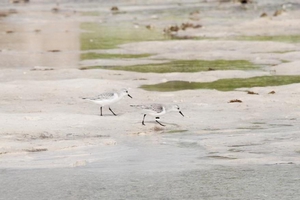 |
| White-breasted Waterhen, the only breeding bird recorded on Dongsha Island (Photo by Hung Teng-Fu, Marine Headquarters) | Sanderling with Chongming Island leg flag (black over white) (Provided by KWBS) |
 |
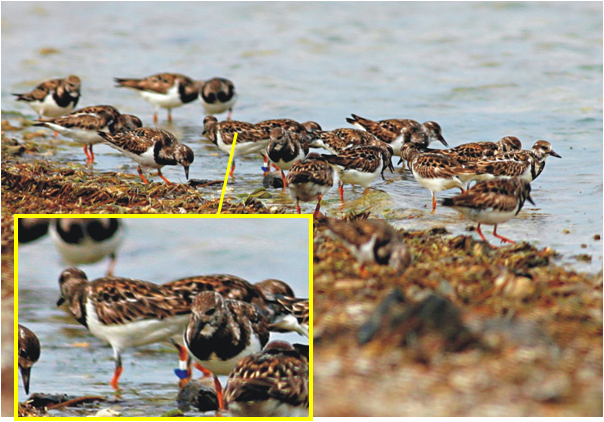 |
| Ruddy Turnstone with southeastern Australia leg flag observed on Dongsha (Provided by KWBS) | Ruddy Turnstones are the largest bird population on Dongsha Island. Note the individual with the Dongsha leg flag (white over blue, clipped corner) (Provided by KWBS) |
 |
|
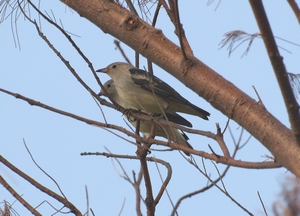
| Daurian Starling, extremely rare in Taiwan, has a stable migratory population on Dongsha Island (Provided by KWBS) |