


On the sandy patches between seagrass beds, a small moon snail quietly crawls by. Here, it is considered a fierce carnivore. Using the broad front edge of its muscular foot, it half-buries itself in the sand. The expanded anterior shield of its foot cleverly pushes aside sand encountered while moving forward, preventing grains from entering the shell. Like a bulldozer, it clears a runway ahead. Two tentacles extend from between the shield and the shell. In addition to sensing light with tiny eye spots at the base of the tentacles, it also receives chemical signals through an olfactory organ (osphradium) located near the front of the gill inside the mantle cavity. Meanwhile, the proboscis at the front of the foot probes through the sand to detect potential prey.
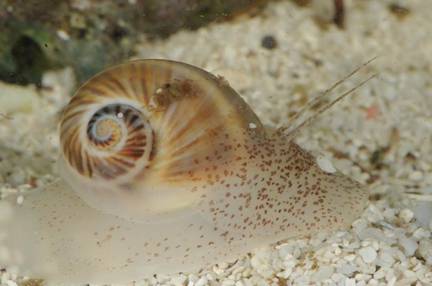 |
| The expanded foot shield of the small moon snail pushing aside sand while crawling – Photo by Hsiu-Min Wang |
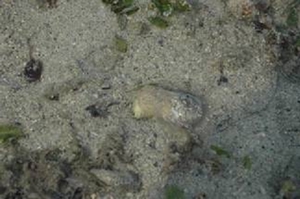
Suddenly, the small moon snail changes direction and turns downward. Beneath the sand lies a bivalve. The moon snail presses down on its prey with its muscular foot and attempts to envelop it. At this life-or-death moment, the bivalve extends its foot and performs a series of rapid extensions and contractions of its hatchet-shaped foot, using torsion to break free from the snail’s grip. The moon snail accelerates in pursuit, while the bivalve attempts unpredictable escape maneuvers. Eventually, as the chase continues, the bivalve becomes exhausted. The moon snail finally captures it, covering it beneath the rear-central portion of its foot, then half-buries itself in the sand with the front of its foot—ready to enjoy its meal.
 |
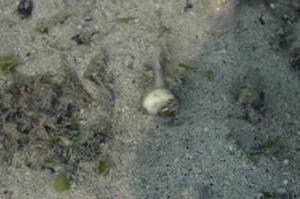 |
| The small moon snail pressing down and enveloping its prey – Photo by Hsiu-Min Wang | The cockle extending its foot in an attempt to escape – Photo by Hsiu-Min Wang |
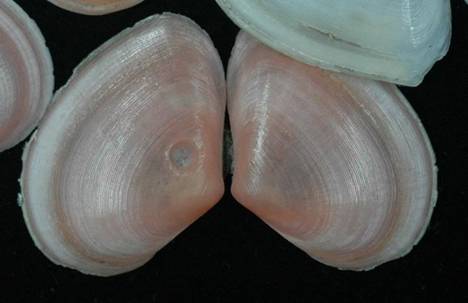
At this point, one might ask: Bivalve shells are so hard—if the shell does not open, how does the moon snail eat the flesh inside? Though the moon snail appears motionless while half-buried in the sand, it is in fact firmly securing its prey with its foot. It secretes acidic saliva from its salivary glands within the proboscis to dissolve the calcium carbonate of the shell. At the same time, it uses its radula to rasp back and forth, drilling a small hole through the shell and scraping out the flesh bit by bit.
 |
|
A clam drilled by a moon snail |
Malacologists have found that when the small moon snail captures its prey, in addition to using acidic secretions to drill into the shell, it also secretes anesthetic mucus that immobilizes the prey, preventing further movement. This process resembles a dental root canal procedure: apply anesthetic, drill a little; inject more anesthetic, drill further; once numb, clean and fill the cavity—restoring a healthy tooth. However, if targeted by a moon snail, the prey may be scraped clean, left with nothing but an empty shell.
Author: Assistant Professor Yu-Wen Chiu, Department of Biomedical Science and Environmental Biology, Kaohsiung Medical University (Project Leader of the 2012 “Survey of Intertidal to Terrestrial Mollusk Resources in Dongsha” commissioned by the Marine National Park Headquarters).