


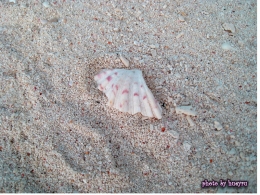
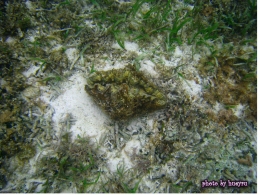
Small fan-shaped shells are often found along the beaches of Dongsha Island. Upon closer inspection, the pure white shells display beautiful purplish-red patterns. These belong to a species of giant clam—the bear paw clam (Hippopus hippopus). As its name suggests, the bear paw clam has a triangular, rhomboid-shaped shell. Unlike other giant clams, Hippopus hippopus does not possess byssal threads for attaching itself to rocks. Instead, it lies openly and horizontally on seagrass beds, sandy bottoms, or among coral rubble. As a result, juvenile bear paw clams—especially those under 10 cm—are often washed ashore after periods of strong winds and heavy waves.
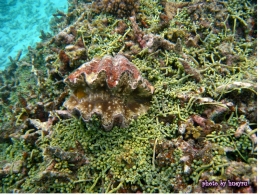
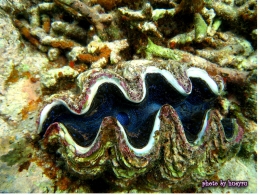
Another feature that distinguishes the bear paw clam from other giant clams is that it typically keeps its shell widely open, resembling a gaping mouth. In addition, it lacks the brightly colored symbiotic algae and pigment cells seen in other giant clams. When viewed from above while swimming, it can easily be mistaken for a dead shell containing decaying flesh.
Because the adductor muscle of giant clams can be eaten as a delicacy similar to dried scallops, and because their shells are often crafted into ornaments and handicrafts, overharvesting has placed giant clams worldwide in jeopardy. In the waters of Dongsha Atoll, mature individuals over 30 cm in size are now rarely seen. The author has met several veterans who were stationed on Dongsha Island 30 to 40 years ago. They fondly recall the beauty of the sea—vivid tropical fish competing in brilliance with corals, large swimming crabs the size of washbasins, and giant clams weighing dozens of kilograms. It is hoped that, under the protection and restoration efforts of Dongsha Atoll National Park, the former splendor of this marine environment may one day be restored. (Text and photos by Chen Hui-ju, Technician, Dongsha Management Station)
 |
 |
 |
 |