


To help elementary school children develop an early understanding of the natural environment, the Marine National Park Headquarters, together with the Kaohsiung Metropolitan Park Station, organized six sessions of the summer program “Little Nature Observers – Nature Ecology Observation Camp” in July. Through these activities, children learned about marine life and grew closer to the ocean. By making use of the rich flora and fauna within Kaohsiung Metropolitan Park, participants gained an in-depth and memorable experience in nature education.
Getting to Know “Trees” – Starting from the Roots
Upon entering Kaohsiung Metropolitan Park, the lush green canopy is the first captivating sight. In recent years, public discussions about tree cutting and tree protection have gradually heightened awareness of the connection between trees and daily life. Beyond the natural law of photosynthesis providing oxygen, trees are also fundamental to addressing global environmental and climate change issues.
During the morning session, interpreters guided students to carefully observe “trees,” explaining how they are structured through the cycle of roots, stems, leaves, flowers, fruits, and seeds. Using close-up photographs, children learned to identify and understand the fundamental characteristics of trees. After building this foundation, the students were divided into groups for field investigations. Guided by instruction cards, they identified species such as crape myrtle, Chinese fan palm, Bauhinia, sweet gum, Chinese pistache, and golden trumpet tree, observing their textures, inflorescences, fruits, and even the insects hidden within bark crevices. The focused figures of these young observers occasionally burst into exclamations upon discovering insects or unique features of tree species, bringing lively energy to the once-quiet woodland.
“The differences between shrubs and trees, or the formation and functions of leaf arrangements, inflorescences, and seeds, all stem from evolutionary adaptations to the environment…” As the children eagerly shared their discoveries, these seemingly professional ecological notes transformed into vivid memories and meaningful learning experiences through close observation and discussion. After the outdoor session, the final morning activity moved indoors, where the interpreter guided students in creating leaf rubbings to capture natural colors, learning how ancient people used wisdom to preserve the hues of nature.
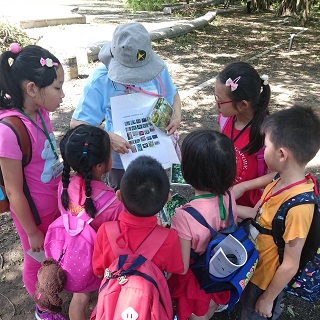
Interpreter introducing tree species characteristics.
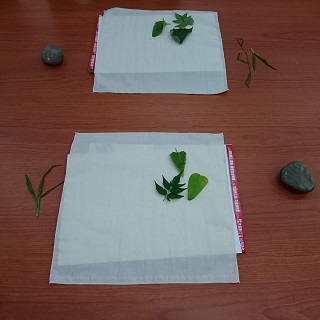
Leaf-rubbing handkerchiefs preserving memories.
Learning About Marine Life Around Us
The afternoon session focused on “Understanding Marine Life, Marine Environments, and Marine Crises.” Although Taiwan is an island nation, many children know marine life only through television, movies, or seafood on the dining table. They may not realize that beyond fish, the vast ocean is home to countless marine organisms of various sizes, each playing vital roles in the marine food chain and significantly influencing marine ecosystems.
Through questions such as “Are seahorses and whales fish?” and “How can we distinguish bony fish from cartilaginous fish?”, interpreters encouraged discussion and brainstorming, deepening students’ understanding of marine organisms. After establishing basic knowledge, children were presented with a list of commonly consumed seafood and participated in a menu-design game. Many were surprised to learn that familiar seafood items such as sea cucumbers, tuna, and grouper can have significant ecological impacts depending on harvesting methods.
At the end of the activity, students eagerly raised their hands to share reflections. Their earnest expressions revealed the profound impact of authentic nature experiences—distinct from computer games—providing broader perspectives and ways of thinking. Before concluding, instructors reminded the children: “Your parents may be busy in daily life, but you can share what you learned today with them so that you can learn from one another.”
This “Nature Ecology Observation Camp” not only fulfilled the goals of environmental education through engaging and interactive activities, but also encouraged parents to create opportunities in daily life to guide children closer to the ocean. By understanding the relationship between humans and marine life, children can root their love for the ocean deeply and put it into practice from an early age.
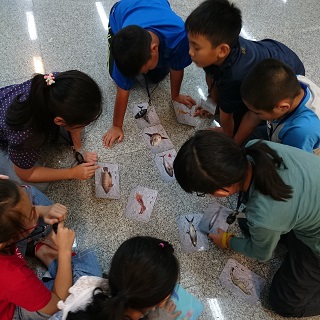
Students practicing a seafood menu exercise to learn responsible seafood choices.
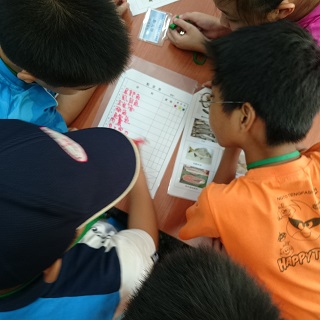
Students engaged in focused discussion.