On April 12, 2015, during a cartilaginous fish resource survey conducted in the waters surrounding Dongsha Island within Dongsha Atoll National Park, the research team captured a tiger shark (
Galeocerdo cuvier)—often referred to as the “tiger of the ocean”—at approximately 4:00 p.m. The tide was at high water, and the shark was caught in waters about 1.5 meters deep along the edge of the wave-dissipating blocks near the island’s second outpost. The specimen was a female, measuring 232 cm in total length, 171 cm in precaudal length, and 188 cm in fork length. Based on its morphological characteristics, this individual is almost certainly a new recorded species for the park.
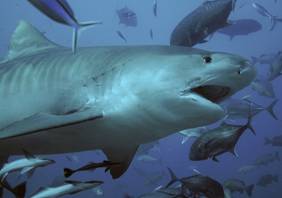
“Scarface-tigershark.” Image from Wikimedia Commons
Licensed under the Creative Commons Attribution 2.5 License
The tiger shark, scientific name
Galeocerdo cuvieri, belongs to the family Carcharhinidae and is the sole species in the genus
Galeocerdo worldwide. Its distinctive vertical stripes resemble those of a tiger, giving rise to its common name. Adult tiger sharks average about 4 meters in length and weigh approximately 400–635 kilograms.
Tiger sharks are widely distributed in subtropical and temperate waters across the world’s oceans, and have been recorded in both southwestern and northeastern waters of Taiwan. Ecologically, they are often found in estuaries, coral reef areas, lagoons, and waters surrounding offshore islands. They exhibit vertical migratory behavior—typically inhabiting deeper waters during the day and moving to surface or shallower waters at night to feed. Among sharks, tiger sharks have one of the broadest diets, with records of garbage, metal fragments, and burlap sacks found in their stomachs. They are ovoviviparous, producing 10 to 82 pups per litter, with newborns measuring 60–104 cm in length. Due to fin consumption and overfishing, the tiger shark is currently listed as Near Threatened (NT) by the IUCN.

Stabilizing the tiger shark (provided by the NCKU Research and Development Foundation team)
The tiger shark captured during this survey would generally be expected to inhabit deeper waters along the outer atoll at night. As for why it appeared in shallow nearshore waters north of Dongsha Island around 4:00 p.m., Associate Professor Chen Yu-yun of the research team noted that studies of Australian seagrass beds and related research indicate a strong correlation between tiger shark distribution and the distribution of their prey (such as rays, sharks, seabirds, dugongs, and sea turtles). However, since the waters around Dongsha Island do not host large numbers of seabirds, sea turtles, or dugongs, it is speculated that the occurrence may be related to the pupping season (April to June) of juvenile lemon sharks and the distribution of rays. Nevertheless, the exact reason remains uncertain and requires further observation. The team hopes that additional records and monitoring will help deepen our understanding of tiger shark behavior. (Text by Chen Kuo-yung, Director, Dongsha Management Station)