


The waters of Dongsha Atoll are extremely rich in marine life, and the intertidal zone at night is particularly vibrant. Many nocturnal animals take advantage of this time to approach the shallow coastal waters to forage or remain active. With a flashlight in hand, strolling along the shore often brings unexpected discoveries. Recently, while conducting a nighttime biological survey in the coral restoration area along the northern shore of Dongsha Island, researchers from the Marine National Park Headquarters collected a juvenile flying fish of the genus Hirundichthys. With its bright yellow, broad pectoral and pelvic fins edged in striking black, the tiny fish swam gracefully through the water, resembling a butterfly fluttering in the sea—a fascinating sight indeed.
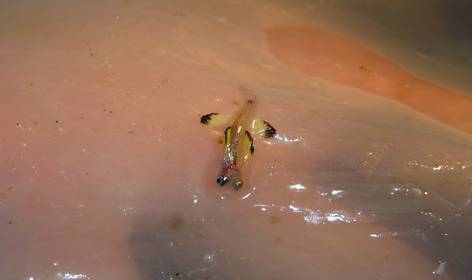
The collected juvenile Hirundichthys sp., approximately 1.5 cm in length. When its pectoral and pelvic fins are spread, it resembles a butterfly fluttering in the sea. (Photo by Liao Chen-heng)
Members of the family Exocoetidae (flying fishes) are oceanic migratory species inhabiting open waters as well as nearshore or shallow surface waters with strong currents. Juveniles have relatively weak swimming abilities and often drift with the waves. As they mature, they become swift and agile to evade predators. When startled, they leap out of the water using their specialized pectoral fins, assisted by their pelvic fins and tail, to glide over long distances. During gliding, the tail fin provides propulsion while the pectoral and pelvic fins maintain balance and lift. They can glide up to 400 meters, which is why this group of fishes is commonly known as flying fish. Flying fishes primarily feed on zooplankton such as crustacean larvae. Their eggs are equipped with adhesive filaments that allow them to attach to floating debris or seaweed.
The genus Hirundichthys is characterized by a more slender body compared to other flying fish species, hence the name. Currently, three species of Hirundichthys have been recorded in Taiwan: Hirundichthys oxycephalus (sharphead flying fish), H. rondeletii (blackwing flying fish), and H. speculiger (mirrorwing flying fish). These species are mainly distributed in waters less than 20 meters deep off Taiwan’s eastern coast. Juvenile flying fish have weaker swimming abilities and therefore may occasionally be found in calm, nearshore waters.
Flying fishes serve as important prey for many large predatory fish species and play a crucial role in oceanic ecosystems. Their migratory patterns often directly influence the feeding migrations of larger fish. Although approximately 25 species of flying fish have been recorded in Taiwan, the species composition around Dongsha Island remains unclear. When vessels navigate the waters of Dongsha Atoll, flying fish are often seen leaping out of the water when startled. Despite their apparent abundance, no comprehensive studies have yet been conducted on their species diversity and ecology in this region.
The specimen collected along the northern shore of Dongsha Island represents the first recorded flying fish of the family Exocoetidae in the waters of Dongsha Atoll National Park. Oceanic fishes are elusive and fast-swimming, making them challenging to survey. Dongsha Atoll National Park, with its unique atoll topography and rich fish diversity, is directly connected to the deep continental slope outside the atoll, linking it closely to the oceanic ecosystem—an exceptional ecological environment. How many members of the flying fish family inhabit or pass through Dongsha Atoll remains to be discovered through future investigations. (Text by Liao Chen-heng)
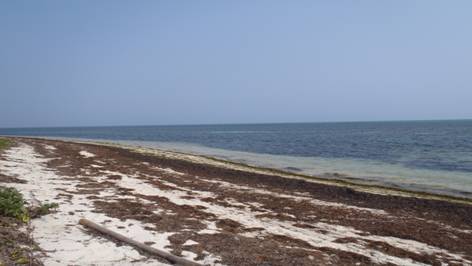
The waters surrounding Dongsha Island are closely connected to the open ocean ecosystem, and many oceanic fish species occasionally appear nearby, especially during their juvenile stages. (Photo by Liao Chen-heng)