


In July 2014, Coast Guard personnel stationed on Dongsha Island discovered an injured fish with a distinctive appearance floating near the shoreline during a coastal patrol. The incident was reported to the Marine National Park Headquarters (MNPH), and the fish was transported to the Dongsha Island Wildlife Conservation Center for treatment. Unfortunately, it later died due to the severity of its injuries. After identification by MNPH researchers, the specimen was confirmed as a new record species for Dongsha Atoll National Park—the Marine Betta (Calloplesiops altivelis Steindachner, 1903).
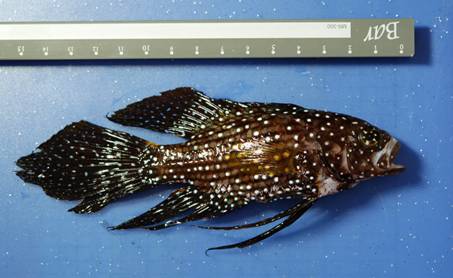
The Marine Betta (C. altivelis), noted for its remarkable mimicry ability, is a newly recorded fish species for Dongsha. (Photo by Yang Shao-min)
The Marine Betta belongs to the family Plesiopidae and genus Calloplesiops. It is a nocturnal, small-sized coral reef fish, reaching a maximum length of approximately 20 cm. It inhabits coral reef walls and reef blocks with abundant holes and crevices, feeding primarily on small arthropods, fish, and polychaetes. The body is laterally compressed with large scales and a protrusible snout. The dorsal and anal fins extend backward, and the caudal fin is pointed. Notably, the last three rays of the dorsal fin bear a conspicuous eyespot. The body is dark brown to black and covered with bright blue spots resembling scattered pearls, which gives the species its common name.
During the day, the Marine Betta typically hides within reef crevices and is difficult to detect. When threatened, it retreats the front half of its body into a crevice and spreads its dorsal, anal, and caudal fins so they merge visually, creating the illusion—enhanced by the dorsal eyespot—of a moray eel peering out from the rocks. This mimicry serves as an effective deterrent to predators. Species in the family Plesiopidae are mostly nocturnal, elusive, and vividly colored, contributing to their long-standing reputation as mysterious reef inhabitants. They are also highly popular marine ornamental fish. Prior to this discovery, only two species of the family had been recorded in Dongsha waters: the Bluestriped Plesiops (Plesiops coeruleolineatus) and the Sharp-headed Plesiops (Plesiops oxycephalus). The specimen collected from the eastern coast of Dongsha Island represents the third recorded species of the family in Dongsha Atoll National Park. With its rich coral reef ecosystems and high fish diversity, Dongsha Atoll National Park may harbor additional members of the Plesiopidae family—further investigations will be needed to uncover the full extent of this diversity. (Text by Liao Chen-heng, Researcher, Dongsha Management Station)
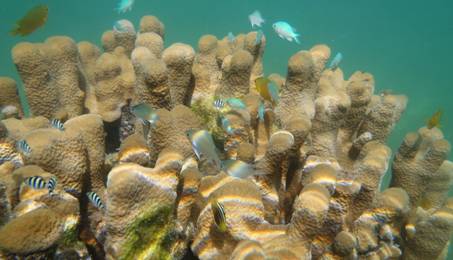
The eastern coast of Dongsha Island features a well-preserved coral reef ecosystem with abundant marine life. (Photo by Liao Chen-heng)
Dongsha Management Station (including Research Station)