


On June 18, 2017, our office organized the “Marine Conservation Lecture Series: The Colorful Hidden Marine Biodiversity.” Dr. Cheng Yu-Jung from the Biodiversity Research Center, Academia Sinica, was invited to introduce the audience to the hidden diversity of marine life and to promote marine conservation concepts. With her humorous and engaging presentation style, Dr. Cheng made the lecture lively and fascinating, greatly broadening the horizons of the participants.
Taiwan’s Unique Geology and Ocean Currents Foster Remarkable Biodiversity
At the beginning of the lecture, Dr. Cheng explained Taiwan’s geographical setting. Located at the intersection of three major marine ecosystems in the western Pacific (the East China Sea, the South China Sea, and the Kuroshio ecosystem), Taiwan is surrounded by the sea on all sides and is characterized as an island. This setting supports exceptionally high biodiversity. Although Taiwan’s land area is relatively small, more than 7,300 marine species have been recorded in the surrounding waters. The diversity of fish, mollusks, corals, and lobsters ranks within the top 10% worldwide. It is estimated that more than 900 additional marine species remain undiscovered.
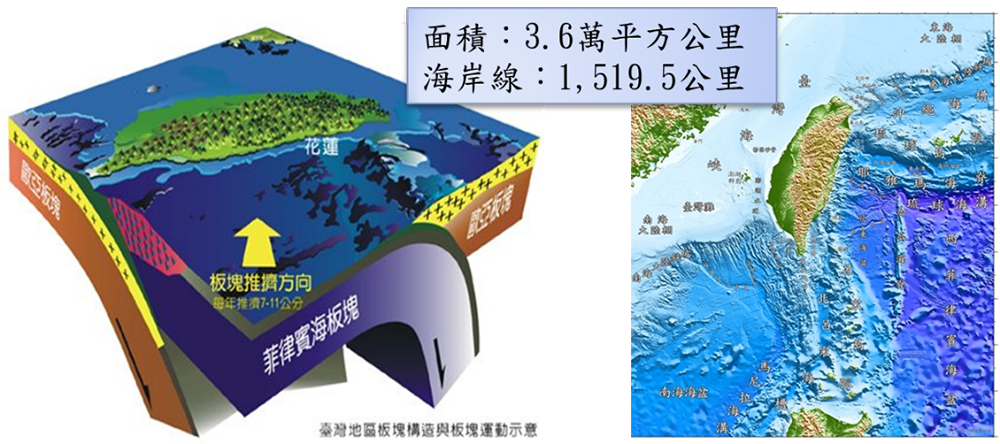
Surrounded by the sea on all sides, Taiwan is a large island. The larger the island, the greater the biodiversity it can support.
(Image source: Provided by Cheng Yu-Jung)
Copepods: Energy Transfer Agents in Marine Ecosystems
Copepods (also known as oar-footed crustaceans) are a subclass or class under the subphylum Crustacea. They are widely distributed across various aquatic environments, including oceans, rivers, lakes, reservoirs, polar regions, hot springs, hydrothermal vents, wells, caves, and groundwater. They can even be found in freshwater at temperatures as low as minus 40°C, and in water accumulated between the leaves of plants such as pineapples.
Planktonic copepods play an essential role in aquatic ecosystems and the carbon cycle. They are major components of zooplankton communities, accounting for approximately 50–80% of total zooplankton abundance. More than 14,000 species have been identified, demonstrating their extraordinarily high species diversity. With an excellent amino acid composition and high levels of protein, lipids, carotenoids, vitamins A and C, unsaturated fatty acids, and minerals, copepods are highly nutritious and easily digested. They have long been used as feed in aquaculture (e.g., brine shrimp) and serve as primary food sources for fish, whales, seabirds, and other crustaceans. At this point, Dr. Cheng humorously remarked, “The reason fried fish smells so good is partly thanks to the microscopic plankton living on fish fins.”
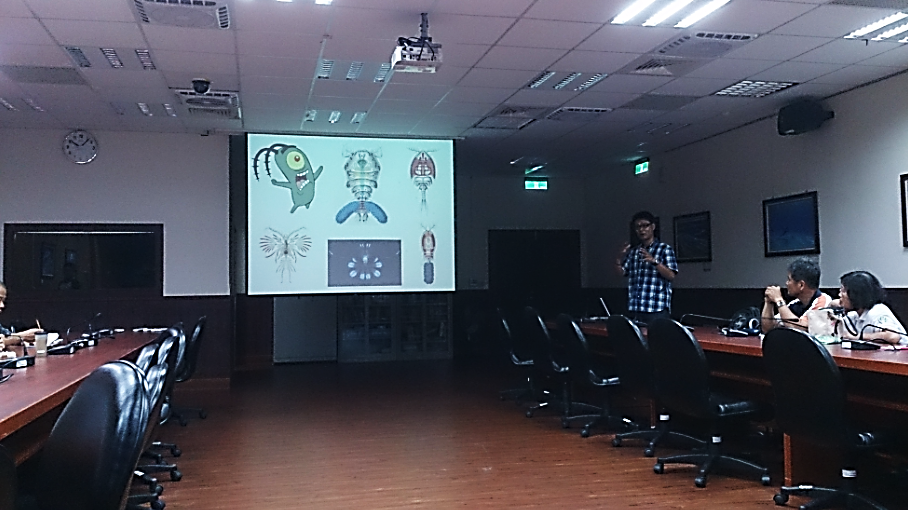
The villain Plankton in the American animated television series SpongeBob SquarePants is a type of copepod.
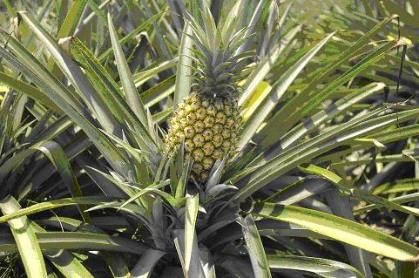
Copepods are widely distributed and can even be found in water trapped between plant leaves.
(Image source: Provided by Cheng Yu-Jung)
Deep-Sea Stony Corals and Habitats Damaged by Bottom Trawling
Most corals rely on symbiotic algae for nutrients produced through photosynthesis and typically grow in waters shallower than 200 meters where sunlight can penetrate. In contrast, deep-sea stony corals lack symbiotic algae and inhabit cold, harsh deep-sea environments with limited energy sources. Current research indicates that known species are solitary forms, growing slowly at an average rate of about 16.1 mm per year. Although scientific information on deep-sea stony coral species remains limited, Dr. Cheng emphasized their ecological significance and impact.
Based on existing research, Dr. Cheng suggested that coral-associated copepods and symbiotic algae may have a symbiotic relationship, with the potential to serve as biological indicators for assessing coral reef health.
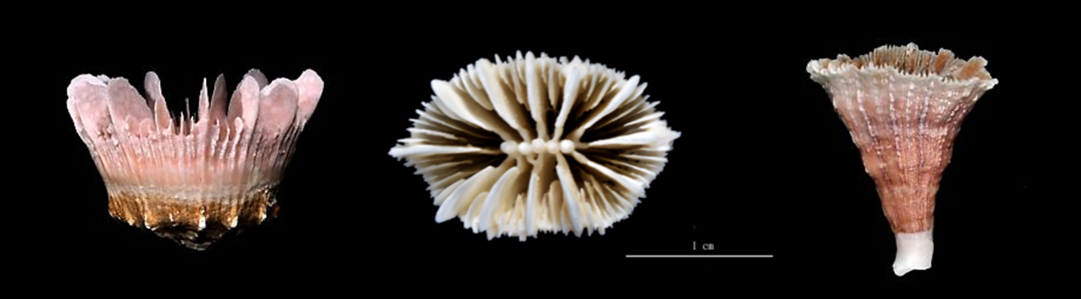
Taiwan’s surrounding waters exhibit exceptionally high species diversity of deep-sea stony corals.
(Image source: Provided by Cheng Yu-Jung)
With advancements in deep-sea exploration technology, studies of deep-sea organisms and ecosystems have revealed that bottom trawling causes far more severe damage to marine habitats than previously understood. Even with conservation and restoration efforts, damaged coral habitats generally require at least 20 years for basic recovery, while deep-sea coral reefs, which grow more slowly, may need 50 years or more. Moreover, even successfully restored areas often experience reduced biodiversity and cannot fully regain their former richness. Therefore, coral reef conservation has become an urgent global issue.
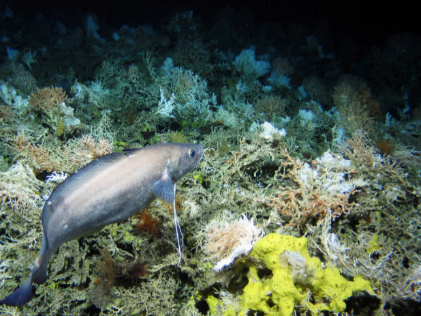
Eighty-five percent of important commercial fish species depend on deep-sea coral reefs for habitat.
(Image source: Provided by Cheng Yu-Jung)
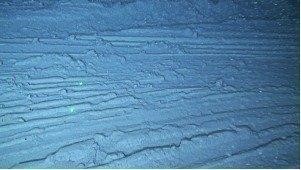
Like the flattened tracks of a tank, bottom trawling causes severe damage to the seafloor environment.
(Image source: Provided by Cheng Yu-Jung)