

On July 16, 2017, our office held the “Marine Conservation Lecture Series: Public Participation in Marine Conservation.” We invited Project Manager Lin Yu-chu from the Taiwan Environmental Information Association to share insights into working at an NGO (Non-Governmental Organization), including ecological conservation, environmental education, and supervision and advocacy efforts, enabling participants to better understand the achievements and journey behind NGO organizations.
What Is an Environmental NGO?
“Does everyone know what environmental groups actually do?” With her neat short hair and sun-kissed complexion, Manager Lin posed this question to the audience immediately after introducing herself. Noticing the puzzled expressions among attendees, Lin Yu-chu went on to explain that the public often associates environmental groups with intense social protests or even labels them as obstacles to economic development. In fact, the core value upheld by environmental organizations is the hope that humanity can coexist peacefully with nature. The website established by the Taiwan Environmental Information Association has accumulated domestic and international environmental news topics and events, including translated environmental reports, documentation of environmental incidents across Taiwan, and participation in environmental impact assessment meetings. It serves as a rich environmental information database that preserves records of important environmental events.
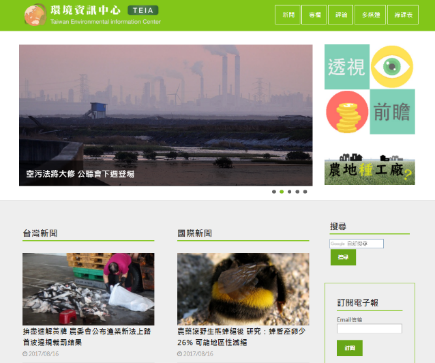
△Taiwan Environmental Information Center website
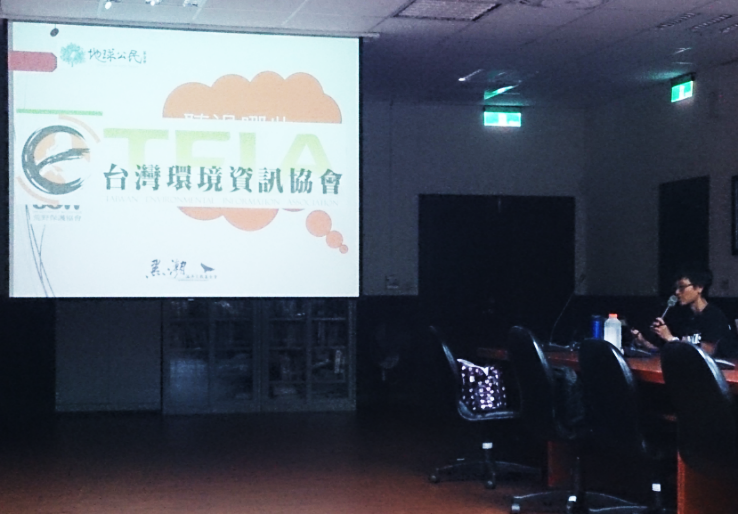
△In addition to the Taiwan Environmental Information Association, Citizen of the Earth, Kuroshio Ocean Education Foundation, Greenpeace, and the Society of Wilderness are also well-known environmental organizations.
Environmental Trusts for Environmental Protection
During the lecture, Manager Lin shared a well-known domestic environmental trust case: the Kuokuang Petrochemical (Eighth Naphtha Cracker) project in Changhua. This marked Taiwan’s first use of an environmental trust mechanism to mobilize public participation in environmental action, garnering widespread public support.
An environmental trust places the “environment” in the hands of a “trusted trustee” to ensure sustainable management in accordance with the trustor’s intent to protect the environment. It has a clear and explicit purpose of environmental protection. Trust assets must be used strictly for the purposes specified in the trust agreement and cannot be arbitrarily altered or disposed of. Once the environment is professionally and properly maintained, the resulting benefits and gains are shared as a public good by an unspecified majority. It is therefore a way of pooling public and multi-sector力量 to jointly participate in environmental affairs.
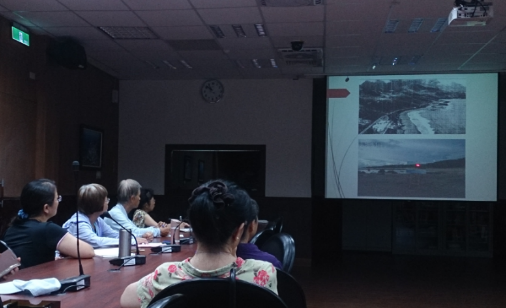
△Audience attentively listening to the Kuokuang Petrochemical case sharing

△“Environmental Trust — An Eternal Promise to the Earth” was published by the Taiwan Environmental Information Association in 2008.
Working Holidays and Coral Reef Health Monitoring
Manager Lin also shared the Miramar Resort controversy at Shanyuan Coast in Taitung. Beyond the privatization of land by corporate interests that infringed upon the traditional gathering practices of nearby Amis Indigenous communities, the project also affected sea turtle nesting habitats on the beach and coral reef ecosystems offshore. Shanyuan Coast features sandy shore terrain, and the hotel building was constructed very close to the shoreline. In addition to public safety concerns regarding the existing structure, soil and debris generated during construction were washed into the sea, causing sedimentation that covered corals. This prevented the symbiotic algae within corals from performing photosynthesis and exchanging substances with seawater. Over time, this could lead to coral suffocation and even death.
In response, the Taiwan Environmental Information Association initiated local working holiday programs and coral reef health monitoring projects. The working holiday program combines volunteer service and ecotourism: volunteers assist with local cultural and environmental preservation, ecological conservation, community maintenance, and historic building preservation, while accommodations and guided tours are provided in collaboration with local residents to generate tangible economic benefits for the community. Coral reef health checks involve investigators diving to assess coral health conditions and recording surrounding marine ecology. Over the years, in addition to Shanyuan Coast and Pisirian, the association has accumulated extensive coral reef monitoring data across Taiwan, including records of the impact of Typhoon Morakot on coral reefs in Lanyu and the gradual decline of coral reefs during the construction of the Miramar Resort in Taitung—demonstrating the importance of long-term monitoring data.
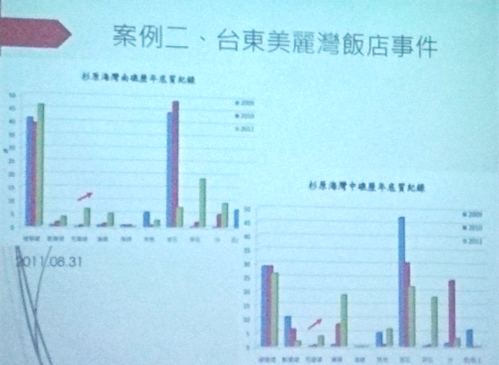
△Historical benthic survey records of the Central and Southern Reefs at Shanyuan Coast
(Image reproduced from Lin Yu-chu’s presentation slides)
Regular Monitoring of Marine Debris
In addressing the severe issue of marine debris pollution, Manager Lin shared the association’s monitoring approach. Since 2013, monitoring sites have been established along the Taoyuan coast, New Taipei’s North Coast, and the Badouzi coast in Keelung, among other locations. Each month, concerned citizens and environmental groups collaborate to conduct beach cleanups, while collected waste from monitoring areas is sorted and analyzed to build a large-scale data source on marine debris. In recent years, data show that cigarette butts are the most common item, followed by bottle caps, disposable tableware, and plastic PET bottles.
Our office began beach debris monitoring in Dongsha Atoll National Park as early as 2011. Multiple sampling zones were established on Dongsha Island, where stationed personnel, together with Coast Guard officers, conduct monthly beach cleanups and debris collection. The concentrated waste is analyzed to determine its origin and type, with PET bottles, Styrofoam, and foam materials being the most common. The long-term monitoring data are publicly released monthly on our website under Conservation Research / Conservation Patrol / Beach Debris Monitoring. We welcome public reference and use.
Through Consumption, Choose the World We Want
For example, marine debris may seem distant from our daily lives, yet most ocean litter originates from human activities on land. We might reflect on how to integrate environmental protection into everyday life. The city of Venlo in the Netherlands has internalized the “Cradle to Cradle” (C2C) sustainability concept into its urban production DNA. The goal is for producers, when manufacturing products, to also consider how their products will ultimately be reclaimed from the broader market and reintroduced into a green circular economy. In this way, materials can continuously circulate and be reused, eliminating waste generated by consumption from the very source of production.
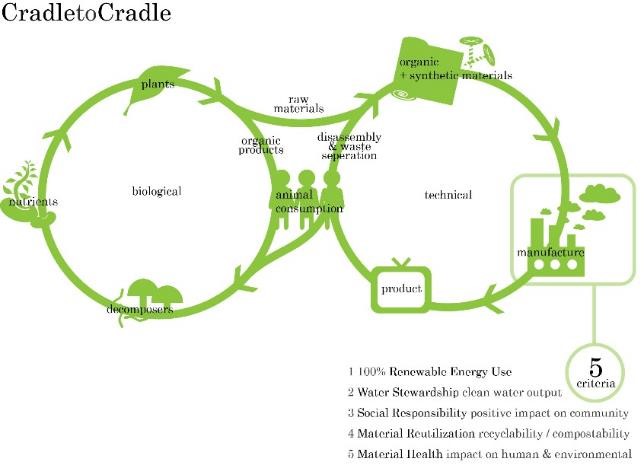
△Conceptual flowchart of Cradle to Cradle biological and technical design cycles
(Image source: https://en.wikipedia.org/wiki/Cradle-to-cradle_design)
There Is No Single Correct Answer in Conservation—Only How Humans and Nature Can Coexist Harmoniously
Environmental organizations consistently stand on the side of protecting nature and often find themselves in disputes with economic development activities. To practice environmental sustainability amid such controversies, it is essential not only to maintain a firm commitment to environmental protection, but also to continuously communicate and coordinate with local residents, corporations, and government agencies. Only through such efforts can a mutually beneficial balance between human activity and environmental protection be achieved. At the end of the lecture, Manager Lin reminded everyone to stay attentive to environmental news and events around them, and to share accurate environmental information with friends and family, so that environmental issues can gain genuine attention and collective consensus through the strength of the public.