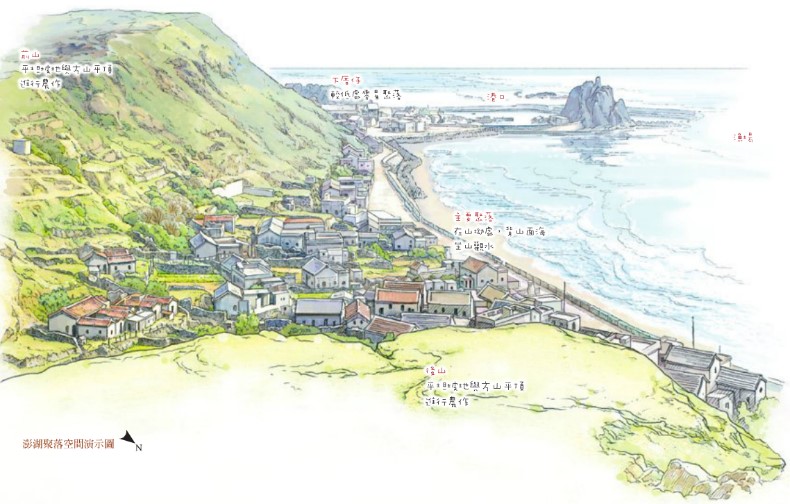


Since Yuping Elementary School was abandoned in 1998, the residents of Dongyuping moved to Sanduo Road in Magong City, building a brand new Dongyuping community. Daching, a young man from Dongyuping, returned to the long-lost Dongyuping Island during his summer vacation. Daching followed his grandfather in going up the hill from the rear mountain, walking across the port, Chifu Temple, the road in front of the old house, the stone wall standing along the steep hill behind the house, the mesa as flat as a table, the beach and tetrapods in front their house...all of them mages of the old house that he was not that he was previously unfamiliar with suddenly became extremely vivid.
While Daching walked along the trail, his grandfather told old stories. He said that there were level ground behind the mountain and houses were concentrated on the level grounds. Residents hid from the blowing wind at the level ground with ocean in front of their house and the port next to the ocean. His grandfather said this was called "observing the situation from the mountain". "Situation" meant the "ocean", meaning that given their geographical location, men will open the door, face the ocean and go fishing, while women will plant vegetables and fruits along the stone walls behind the mountain.
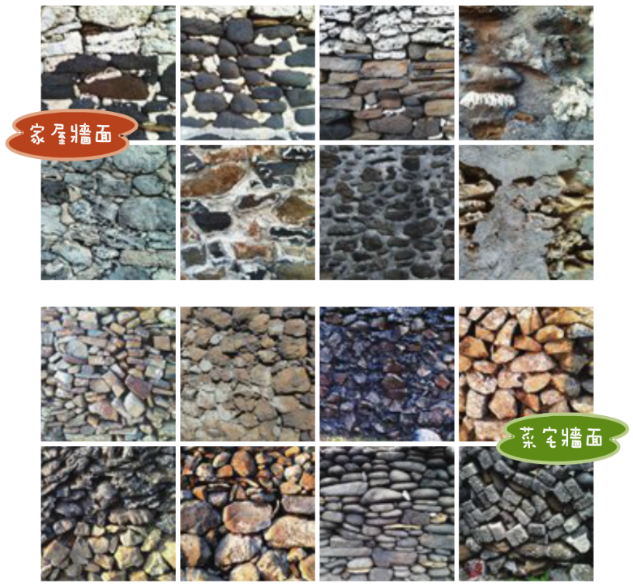
Then Daching's grandfather mentioned something he had to tell him. He said that when men of Dongyuping Island was preparing to get married, they had to carry coral stones from the sea bank for three years to accumulate enough stones to build their own house! Although both coral stones and basalt were in crooked shapes, lime burnt out of Lingzi will be used to fill in the gaps after the stones were stacked. Lingzi is coral reef fragments that were accumulated along the sea banks of Penghu that contains foraminifera, shell sands and other substances. After the Japanese Colonial Era, cement and granitoid were introduced to Penghu and coral stones were no longer used that often to build houses.
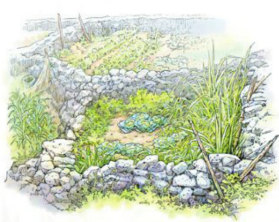
Daching faced towards the endless stone walls that stretch from the front mountain to the rear mountain; wondering why his ancestors had to put that much effort into building stone walls for vegetable crops. His grandfather said that, given that Penghu is covered under the northeastern monsoon for around 6 months every year, the salt within the sea water vapor is destructive to the crops when the wind was blowing hard. Facing the powerful and salty northeastern monsoon, vegetable crops would wither if the stone walls were not built to protect them. By then, only sorghum, sweet potato and peanuts could be harvested. After women harvested from behind at the stone walls, they can cook a great meal to fill up the family's stomachs when combined with the seafood caught by men.
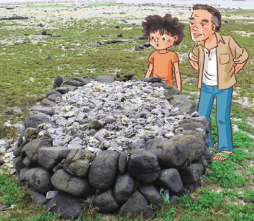
Many illegible tombs could be found at the rear mountain of Dongyuping Island. They are mostly made out of basalt, with a handful ones made on coral stones. This graveyard was their last home for the residents of Dongyuping. Due to the change of time, most people's tombs have relocated to Penghu.
Listening to his grandfather's old stories, Aching realized that coral stone was not only a kind of build material for the people of Dongyuping Island to live safely and cozily, but also an important cultural element that was incorporated within local families.
For the residents of Southern Penghu Four Islands, coral stone is closely related to their life from marriage, agriculture, until their resting graveyard. When visiting the four Southern Penghu Four Islands, stop your steps and have a good look on these coral stone buildings to discover the ancestors' cultural wisdom in using local materials.