


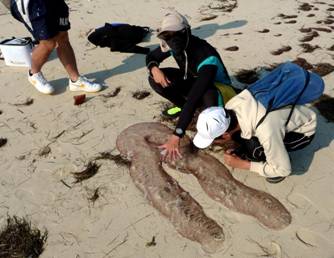
Under the influence of the northeast monsoon in spring, unidentified gelatinous objects were discovered on the sandy shores of the Dongsha Island lagoon. After further comparison and analysis by Professor Chiu Yu-wen of Kaohsiung Medical University, the material was confirmed to be egg masses of the diamondback squid, commonly known as the flying squid. This discovery suggests that the waters surrounding Dongsha Atoll National Park may also serve as spawning grounds for this species.
The diamondback squid (flying squid) is a large, one-year-lifespan cephalopod species distributed across tropical and subtropical waters of the world’s three major oceans. It typically inhabits waters deeper than 300 meters. Due to its wide distribution and the difficulty of harvesting large quantities, much about its ecology and life history remains unclear. Floating egg masses have often been observed in surface waters off central and southern Japan. In Taiwan, records exist of stranded individuals and egg masses found along the coasts of Taipei, Suao, Taitung, and Penghu. In southern Sulawesi waters of Indonesia, egg masses measuring up to two meters in length and 15 centimeters in diameter have also been recorded. This marks the first discovery of such egg masses in Dongsha waters, confirming the presence of diamondback squid in the surrounding area. As the Sea of Japan and waters around Okinawa are major fishing grounds for this species, most previous research has been conducted by Japanese scientists. Further study is therefore needed to better understand the species’ life history, migratory routes, and population distribution in Taiwan’s waters.
Since the establishment of Dongsha Atoll National Park under the Marine National Park Headquarters, efforts have focused not only on terrestrial and marine resource restoration but also on active resource surveys. Ongoing research has led to a series of new findings. In the face of climate change and the consequences of excessive exploitation of natural resources, conservation efforts are more urgent than ever. Supporting the establishment of marine protected areas is one of the concrete actions we can take to demonstrate our commitment to protecting the Earth.
For more details about Professor Chiu Yu-wen’s team’s discovery process, please visit the Marine National Park Headquarters website (http://www.marine.gov.tw/) under Ecology & Conservation → Marine Conservation News → Marine Knowledge, and refer to the article titled “Sea Dragon King’s Vermicelli – The Flying Squid Egg Masses Drifting into the Dongsha Lagoon.”
 |
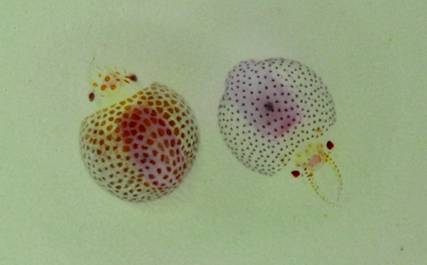 |
| Figure 1: Elongated gelatinous egg mass discovered on the sandy shore of the Dongsha Island lagoon. | Figure 2: Newly hatched diamondback squid. |