


After two months of continuous observation and sampling surveys, the Marine National Park Headquarters (hereinafter referred to as the Headquarters) overcame unfavorable sea conditions and successfully recorded coral spawning at Dongsha Atoll once again on the night of April 28, 2013.
To capture this critical coral spawning event, investigators from the Headquarters and National Sun Yat-sen University began monitoring coral gonad development as early as early March. In order to avoid missing the corals’ reproductive cycle, personnel were deployed in relay shifts to conduct nightly underwater surveys. Their perseverance was rewarded on April 28, 2013, when they documented coral spawning behavior at Dongsha, leaving behind valuable records of the atoll’s vibrant marine life.
Located in the northern South China Sea, Dongsha Atoll was formed through millions of years of coral growth and accumulation. It is the only fully developed coral atoll within Taiwan’s waters. Adjacent to the globally recognized Coral Triangle—an area with the highest marine biodiversity in the world—Dongsha is one of Taiwan’s marine biodiversity hotspots and an ideal site for coral reef biodiversity research.
Since its establishment in October 2007, the Headquarters has conducted long-term investigations into coral spawning (sexual reproduction) at Dongsha Atoll. In addition, it has actively promoted coral restoration through artificial transplantation and fragment propagation (asexual reproduction) to expand coral seed sources. To date, two large patch reef restoration experimental sites have been completed, each consisting of 54 transplanted coral branches. Furthermore, five years of monitoring have shown that coral cover in the Dongsha lagoon has gradually recovered, increasing from an original range of 2–50% to 17.5–71.5%. These results demonstrate that coral conservation efforts following the establishment of the National Park have achieved significant success. In the future, the Headquarters will continue promoting coral reef conservation to safeguard the rich marine environment and ecosystems of Dongsha Atoll National Park.
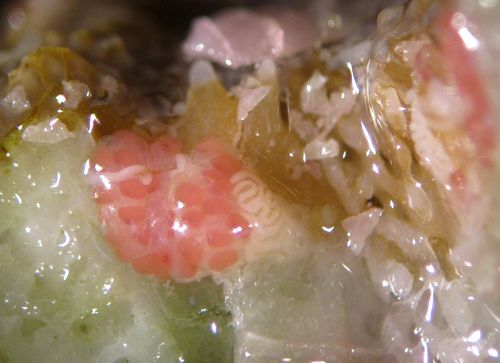
Sampling of daisy coral, with red and white egg-sperm bundles visible

Daisy coral during spawning

Coral restoration work conducted by the Headquarters. Left: branching coral fragments transplanted in 2011; right: condition after one year of cultivation
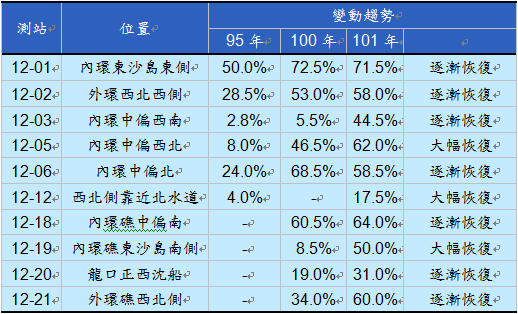
Trend of coral cover changes in Dongsha Atoll National Park over the years