


The Marine National Park Headquarters (hereinafter referred to as the Headquarters), in collaboration with the Institute of Wildlife Conservation at National Pingtung University of Science and Technology, unexpectedly captured three rare protected coconut crabs (commonly known as robber crabs) while conducting rodent monitoring surveys on Dongsha Island. This marks the second consecutive year that coconut crabs have been observed on Dongsha Island since the establishment of the Dongsha Management Station of Dongsha Atoll National Park (the previous record was one individual found in June 2008). The finding indicates that conservation efforts at Dongsha Atoll National Park are yielding positive results.
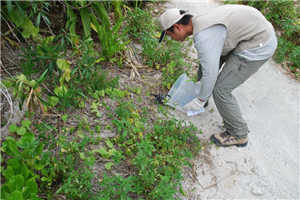
The Headquarters stated that during this year’s commissioned rodent monitoring survey, two coconut crabs were discovered on July 17 in the central area of the island, and a third individual was found on the morning of July 19 in the inner lagoon area, totaling three individuals. Measurements taken by Dongsha Management Station personnel showed an average carapace length of 6.4 cm and an average weight of 180 grams. These individuals were assessed to be juveniles and had not yet reached maturity. After completing the measurements, all three crabs were immediately released at the site of capture.
According to the literature, the coconut crab (Birgus latro) belongs to the class Crustacea, order Decapoda, family Coenobitidae. It is distributed across tropical islands in the Indo-Pacific region and is the largest terrestrial hermit crab species. Adult individuals can weigh between 1 and 6 kilograms, with a carapace length exceeding 15 centimeters. The species is named for its ability to use its powerful claws to crack open coconuts to feed on the flesh. During the day, coconut crabs typically hide beneath rocks or within coral reef crevices in coastal forests. In Taiwan, they are mainly found along the east coast, the Hengchun Peninsula, and on Green Island and Orchid Island. However, they are now rarely seen on Taiwan’s main island, and their populations on Green Island and Orchid Island have also declined significantly. Habitat destruction and human poaching have led to drastic population decreases, making strict protection essential.
The Headquarters noted that since the establishment of the Dongsha Management Station in March 2008, conservation researchers have been stationed on the island to actively conduct habitat restoration and conservation work. Efforts include the removal of invasive species such as Leucaena leucocephala, as well as the cultivation and planting of native vegetation such as beach naupaka, Scaevola, and other indigenous plant species. In addition, marine ecological education programs have been provided to Coast Guard personnel stationed on the island to promote proper conservation awareness. Joint beach cleanups and environmental maintenance activities have also been carried out. These actions are expected to strengthen marine biodiversity. The Headquarters will continue habitat restoration and ecological conservation efforts to safeguard the biodiversity of Dongsha Island.
 |