

When we walked on the trails of the four Islands of Southern Penghu, you may find some fonts inlaid on the lintel of a front door of some houses. However, these fonts are not this family's surnames, so what do they mean? Although these fonts are not surnames, they have a deep relationship with surnames. Those are the hall names related to this family.
The hall name can be regarded as the origin of each surname, and it is also the denomination of each surname. These hall names indicate the origin of the family as well as in memory of the ancestors’ entrepreneurial traditions. The names of each hall were given based on diverse reasons. Most of them are given based on the origin place of family, such as "Hedong hall " of Lv & Liu, etc., "Xihe hall " of Lin & Mao, "Yingchuan hall " of Chen & Zhong. Some of them are also related to ancestors' virtues and merits, such as "Sizhi hall " of Yang, or the bestowed by the emperor, such as "Baoshu hall " of Xie surname. These hall names not only represent the close blood relationship of the family but serve as one of the precious memories inherited from ancestors. On four Islands of southern Penghu, a land sealed by time, hall names that are becoming less common on the island of Taiwan can still be found easily.
In the four Islands of southern Penghu, each island has its distribution of surnames that can be found in the household registration materials during the Japanese occupation and on the donation monuments of temples. There have been as many as 30 surnames on Dongji Island. Among them, Lin is the most common surname, Xu is the second, and Chen is the third ones.
In Xiji, there were 25 surnames. The Chen is the most common surname, accounting for half of the island’s population, followed by Wu whose population were are only 1/3 of Chen, Hsu is the third ones.
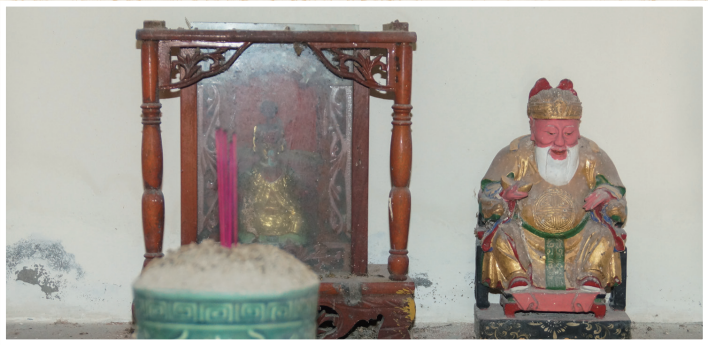
Although there were so many surnames on the four islands, more than half of them were the surnames of women who were married into the island or the surnames of immigrants from other places.
Therefore, the population with such surnames was usually relatively small. In Dongyuping, there was a special case related to the change in the proportion of surnames result from marriage. During the Japanese Occupation, a man named Zhong Ge on Dongyuping island was recruited as the son-in-law to Xu's family in Tseung Kwan Oh of Wanan and lived in the Xu Shihao’s house in Dongyuping later. At the time of entering the marriage, the two parties agreed that after Mr. Zhong has served the wife's parents for over a century, his children and grandchildren can freely change their surnames.