

Dongsha Island is located at the northernmost edge of the South China Sea and serves as a hub of maritime transportation in the region, holding significant national security and strategic importance. Since the Tang Dynasty, ships from various countries sailing across the South China Sea had the opportunity to sight Dongsha Atoll, which was then referred to as the “Thousand-Mile Shitang.” Owing to its unique geographic environment, the waters around Dongsha Island have long been excellent fishing grounds, attracting numerous fishermen—primarily from Guangzhou and Fujian. These fishermen used Dongsha as a temporary residence, resting on the island after fishing operations and storing provisions and catches there, leaving behind traces of their activities. In 1907, Japanese entrepreneur Nishizawa Yoshitsugu led a group to Dongsha Island and extensively mined guano deposits, causing irreparable damage to both the island’s cultural landscape and natural ecology. From 1949 onward, the Ministry of National Defense assumed responsibility for safeguarding the South China Sea islands, giving Dongsha Island a strong military presence. All these historical layers have contributed to the evolving heritage and changes seen on Dongsha Island today.
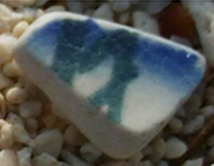
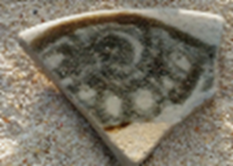
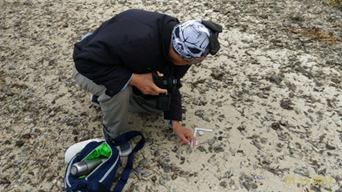
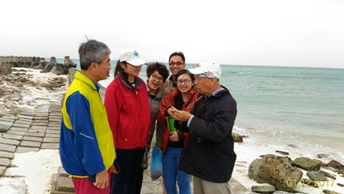
Among the historical relics found on Dongsha Island, fragmented ceramic shards are the most abundant. By examining decorative patterns and painting techniques on these pieces, it is possible to infer their production periods. In 2017, Professor Chen Hsin-hsiung from the Department of History at National Cheng Kung University conducted an on-site investigation of ancient ceramic shards on Dongsha Island, allowing us to revisit the island’s historical memory and its external maritime connections. Professor Chen circled the island to examine the condition and distribution of terrestrial cultural remains. Over three days of investigation, a total of 29 ceramic shards were discovered: 8 on the east coast, 2 on the west coast, 14 on the south coast, and 6 on the north coast. The places of origin were mainly Guangdong and Fujian in China, as well as Taiwan and Japan—18 pieces from the former regions, 8 from the latter, and 3 pieces pending further identification. The dating of these shards ranges from the mid-Qing Dynasty, late Qing Dynasty, late Qing to early Republic period, Japanese colonial era, early postwar period, to postwar years. The largest numbers date to the late Qing period (10 pieces) and the late Qing to early Republic period (5 pieces). Through this exploration of ancient ceramic fragments, we are able to reflect on Dongsha’s historical legacy and its role in South China Sea maritime transportation.