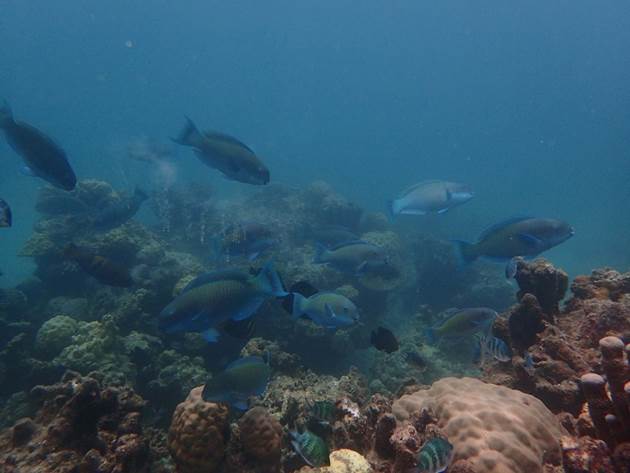


The Marine National Park Headquarters (MNPH), together with the Dongsha International Marine Research Station of National Sun Yat-sen University, has completed the 2017 (Year 106) comprehensive survey of coral reefs in the waters of Dongsha Atoll National Park. The results of this year’s survey show that the average coral cover is approximately 63%. Coral cover at the outer reef stations was slightly affected by typhoon waves, while the lagoon areas, due to limited water exchange, generally have lower coral cover, with corals mainly consisting of pressure-resistant massive or plate-like forms.
Dongsha Atoll National Park is located in the northern part of the South China Sea and consists of Dongsha Island and a large ring-shaped reef platform. The surrounding waters have steep depth gradients and good water exchange, favorable for coral growth. MNPH and Sun Yat-sen University conducted surveys across 8 fixed stations with a total of 10 transects this year. Among the outer reef stations, the southern reef platform had the highest coral cover at 83.75%, followed by the eastern reef platform at 76.25%, the northern reef platform at 61.25%, and the western reef platform at 60%. In the lagoon, due to semi-enclosed conditions and poor water flow exchange, summer seawater temperatures were relatively high and suspended particles abundant, limiting coral growth. Coral cover along the five transects averaged only 33%, indicating slow recovery.
This year’s survey results show that the southern reef platform on the outer atoll had the best coral cover, dominated by table-shaped, plate-shaped, and encrusting corals that resist strong currents. The northern and eastern reef platform stations, however, were slightly affected by typhoons that struck Dongsha in the latter half of last year and the first half of this year. For example, the northern reef platform’s coral cover, which was 89.0% in the 2016 survey, has dropped to 61.25% this year. Many exposed rock substrates were observed where corals had been removed. Since soft corals dominate the northern reef platform stations, they are more vulnerable to typhoon waves, especially in water depths of 5–6 meters. Coral growth in the lagoon varies by type. The lagoon floor, with high water temperature and high suspended particles, remains unsuitable for coral growth, with widespread dead coral fragments and cover ranging from 0–20%. However, some areas feature extensive growth of Porites corals; for example, the eastern lagoon station near Dongsha Island has coral cover as high as 85.63%, though this is mostly a single species, with some heat- and particle-resistant faviid and massive corals interspersed. Coral cover on massive coral reefs in the lagoon is slightly better at 22–38%. Due to high water temperatures, corals in the lagoon are dominated by stress-tolerant species such as porites, acropora, and tubastraea, which grow slowly, leading to slower recovery. MNPH has been conducting coral restoration in the lagoon, transplanting heat-tolerant Acropora species to enhance habitat diversity.
Regarding indicator species, most stations continue to meet the standard values for butterflyfish and giant clams. The outer reef stations, dominated by low, clustered corals, offer limited shelter space for fish, resulting in mainly small fish species and fewer sedentary species. In contrast, the lagoon provides more habitat space on massive reefs, allowing observation of larger fish such as parrotfish, groupers, and snappers. Overall, indicator fish species meet standards best at the southern reef platform stations. Besides giant clams, other invertebrates are rarely seen. In addition to coral reefs, Dongsha Atoll National Park also has extensive seafloor areas that are important marine ecosystems. An assessment plan for eco-tourism is currently underway, with hopes to open to the public in the near future.
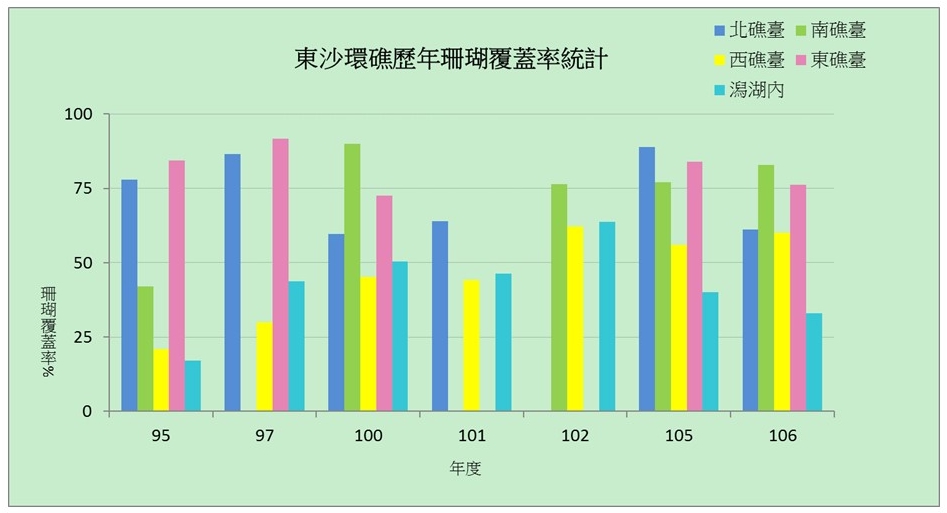 Survey results of coral cover in Dongsha Atoll National Park over the years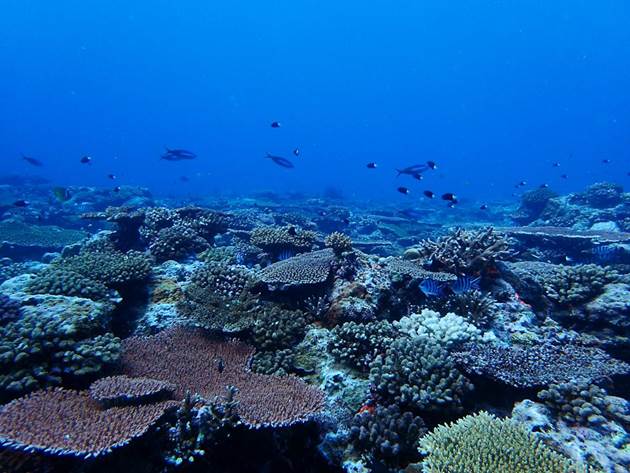
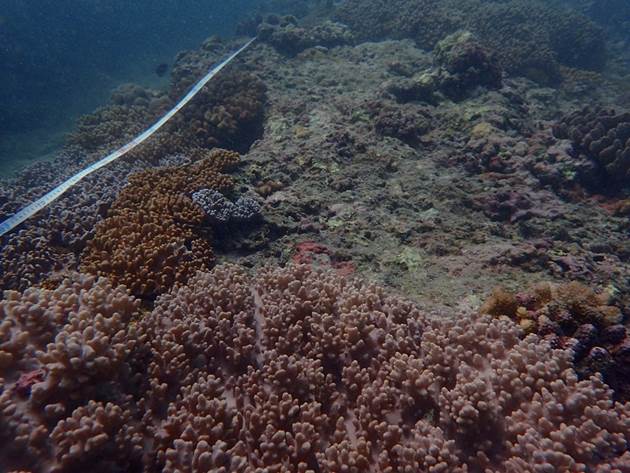 Northern reef platform stations affected by typhoons, showing exposed rock where soft corals were removed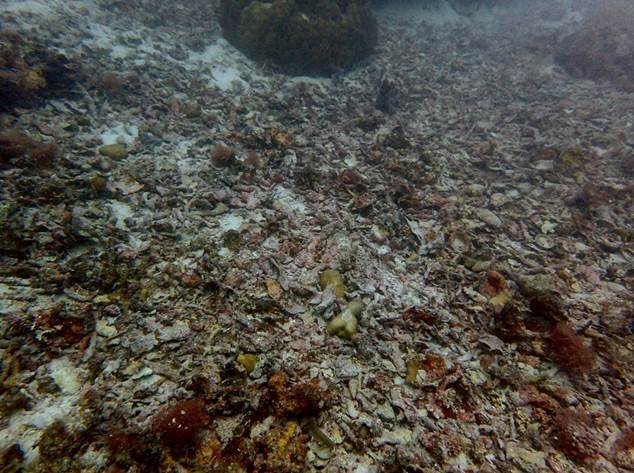
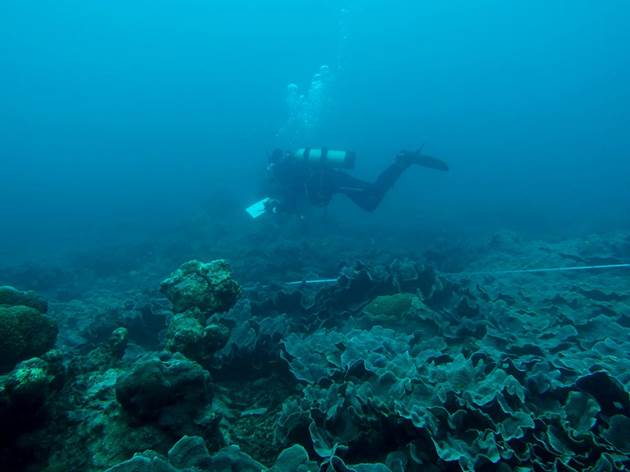
Certain areas in the lagoon are covered by Porites corals