

To promote the Penghu Southern Four Islands as an environmental education platform featuring basalt geology, marine ecology, and settlement culture, the Marine National Park Headquarters (hereinafter referred to as MNPH) organized two sessions of the “Marine Seed Teacher Training Camp” from August 9–12 and August 16–19, 2013. A total of 67 elementary and junior high school teachers, along with interpretation volunteers, participated in the program. Through courses focusing on the geology, ecology, and cultural characteristics of the Southern Four Islands, participants served as “seeds,” helping marine conservation concepts take root and grow steadily in educational settings.
The Penghu Southern Four Islands (Dongji Islet, Xiji Islet, Dongyuping Islet, and Xiyuping Islet) are basaltic volcanic islands. Among them, Dongyuping Islet represents the final stage of volcanic activity in the Penghu region, giving it special geological significance. The four islands are characterized by distinct mesa landforms. Local residents historically settled in sheltered valleys, forming communities that face the sea and back onto the mountains. Basalt was used as the primary building material, and windbreak vegetable enclosures known as “caizhai” were constructed to support agriculture. These features demonstrate how human settlement and cultural development are closely intertwined with local geology and topography.
MNPH invited Professor Chen Wen-shan and Professor Sung Sheng-rong of National Taiwan University, as well as Professor Chi Shih-cheng of National Kaohsiung Normal University, to lecture on the volcanic geology, landforms, and natural resources of Penghu and the Southern Four Islands. The curriculum also incorporated presentations by two local Penghu cultural historians: Mr. Hung Kuo-hsiung and Principal Yen Shen-kao, who shared insights into the natural resources of the Southern Four Islands and the cultural settlement of Huazhai in Wangan Township. During the final stage of each session, participating teachers and interpreters collaborated in brainstorming workshops to develop marine geology lesson plans and learning worksheets. These materials are expected to serve as valuable resources for future marine geological environmental education outreach.
Promoting marine environmental education has always been a key mission of MNPH. By building a friendly and accessible marine education platform, MNPH aims to enable the public to experience the rich and diverse terrestrial and marine natural resources of the region. Step by step, MNPH continues to move toward the goal of “Understanding the Ocean, Approaching the Ocean, and Loving the Ocean.”
The Penghu Southern Four Islands (Dongji Islet, Xiji Islet, Dongyuping Islet, and Xiyuping Islet) are basaltic volcanic islands. Among them, Dongyuping Islet represents the final stage of volcanic activity in the Penghu region, giving it special geological significance. The four islands are characterized by distinct mesa landforms. Local residents historically settled in sheltered valleys, forming communities that face the sea and back onto the mountains. Basalt was used as the primary building material, and windbreak vegetable enclosures known as “caizhai” were constructed to support agriculture. These features demonstrate how human settlement and cultural development are closely intertwined with local geology and topography.
MNPH invited Professor Chen Wen-shan and Professor Sung Sheng-rong of National Taiwan University, as well as Professor Chi Shih-cheng of National Kaohsiung Normal University, to lecture on the volcanic geology, landforms, and natural resources of Penghu and the Southern Four Islands. The curriculum also incorporated presentations by two local Penghu cultural historians: Mr. Hung Kuo-hsiung and Principal Yen Shen-kao, who shared insights into the natural resources of the Southern Four Islands and the cultural settlement of Huazhai in Wangan Township. During the final stage of each session, participating teachers and interpreters collaborated in brainstorming workshops to develop marine geology lesson plans and learning worksheets. These materials are expected to serve as valuable resources for future marine geological environmental education outreach.
Promoting marine environmental education has always been a key mission of MNPH. By building a friendly and accessible marine education platform, MNPH aims to enable the public to experience the rich and diverse terrestrial and marine natural resources of the region. Step by step, MNPH continues to move toward the goal of “Understanding the Ocean, Approaching the Ocean, and Loving the Ocean.”
 |
 |
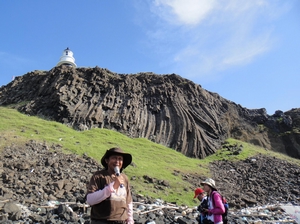
| Professor Chen Wen-shan of National Taiwan University lecturing on the basalt structure of Dongji Islet (Photo courtesy of MNPH) |
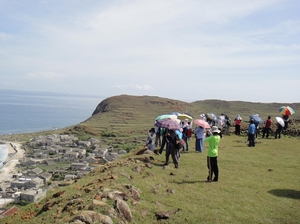
Terraced vegetable enclosures and settlement landscape on Dongyuping Islet (Photo courtesy of MNPH) |
 |
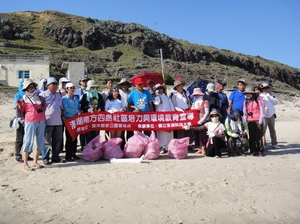 |
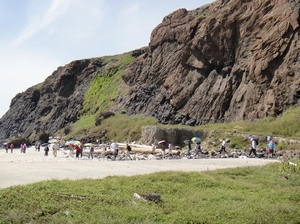
| MNPH Section Chief Chuang Cheng-hsien introduces the “Eye of Dongji” (Photo courtesy of MNPH) | Working together to protect the ocean through beach cleanup activities (Photo courtesy of MNPH) |