


In November 2014, researcher Liao Chen-heng of the Marine National Park Headquarters conducted routine biological sampling along the western coast of Dongsha Island and discovered a small, dark-colored fish approximately 4 cm in length on sandy substrate within a seagrass bed. After collecting the specimen and examining it in the laboratory, it was identified as a new family and species record for Dongsha Atoll National Park—the juvenile of the Striped Threadfin (Polydactylus plebeius Broussonet, 1782).
The Striped Threadfin belongs to the family Polynemidae and genus Polydactylus. It is an economically important species, reaching a maximum length of about 45 cm. It is widely distributed from the Indian Ocean to the Pacific Ocean. In Taiwan, it occurs in sandy or muddy shallow waters less than 20 meters deep along the northern, central, southern coasts and offshore islands. The body is laterally compressed and elongated, with a blunt, rounded snout. Although it may occasionally prey on small fish, it primarily feeds on fish, shrimp, crabs, and polychaetes living within sandy or muddy substrates. Reflecting its feeding habits, the mouth is positioned inferiorly, facilitating bottom feeding.
The Striped Threadfin is named for the five free, filamentous rays located below its pectoral fins. These specialized rays function as sensory organs for detecting prey. Equipped with sensitive cells, they can perceive benthic organisms hidden within the sand. Once prey is detected, the fish uses its mouth to excavate and feed. With such precise and efficient foraging abilities, calling this species a “biological detector of the sea” is no exaggeration.
Adult threadfins are generally gregarious and exhibit seasonal migratory behavior. Mature individuals typically display a silvery-gray body coloration. The collected specimen, however, was a solitary juvenile and appeared unevenly dark brown, possibly due to environmental stress. Its distinctive head-shaking movements were particularly striking. After identification and documentation, the fish was returned and released at its original capture site.
The seagrass beds along the western coast of Dongsha Island are interspersed with various habitat types such as sandy areas and patch reefs, collectively creating a unique and highly biodiverse environment. Members of the family Polynemidae had not previously been recorded in the waters surrounding Dongsha Atoll. Given that only a single juvenile individual was found, further research is required to determine whether a resident adult population exists in this area. (Text by Liao Chen-heng, Contracted Researcher, Dongsha Management Station)
The Striped Threadfin belongs to the family Polynemidae and genus Polydactylus. It is an economically important species, reaching a maximum length of about 45 cm. It is widely distributed from the Indian Ocean to the Pacific Ocean. In Taiwan, it occurs in sandy or muddy shallow waters less than 20 meters deep along the northern, central, southern coasts and offshore islands. The body is laterally compressed and elongated, with a blunt, rounded snout. Although it may occasionally prey on small fish, it primarily feeds on fish, shrimp, crabs, and polychaetes living within sandy or muddy substrates. Reflecting its feeding habits, the mouth is positioned inferiorly, facilitating bottom feeding.
The Striped Threadfin is named for the five free, filamentous rays located below its pectoral fins. These specialized rays function as sensory organs for detecting prey. Equipped with sensitive cells, they can perceive benthic organisms hidden within the sand. Once prey is detected, the fish uses its mouth to excavate and feed. With such precise and efficient foraging abilities, calling this species a “biological detector of the sea” is no exaggeration.
Adult threadfins are generally gregarious and exhibit seasonal migratory behavior. Mature individuals typically display a silvery-gray body coloration. The collected specimen, however, was a solitary juvenile and appeared unevenly dark brown, possibly due to environmental stress. Its distinctive head-shaking movements were particularly striking. After identification and documentation, the fish was returned and released at its original capture site.
The seagrass beds along the western coast of Dongsha Island are interspersed with various habitat types such as sandy areas and patch reefs, collectively creating a unique and highly biodiverse environment. Members of the family Polynemidae had not previously been recorded in the waters surrounding Dongsha Atoll. Given that only a single juvenile individual was found, further research is required to determine whether a resident adult population exists in this area. (Text by Liao Chen-heng, Contracted Researcher, Dongsha Management Station)
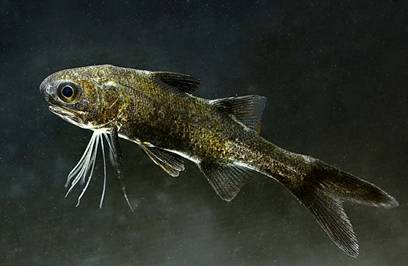
New fish record for Dongsha Atoll National Park — Striped Threadfin (P. plebeius) (Photo by Wang Chuan-yu)

The seagrass beds along the western coast of Dongsha Island contain diverse habitat types and support high biodiversity. (Photo by Liao Chen-heng)
The seagrass beds along the western coast of Dongsha Island contain diverse habitat types and support high biodiversity. (Photo by Liao Chen-heng)
Dongsha Management Station (including Research Station)