


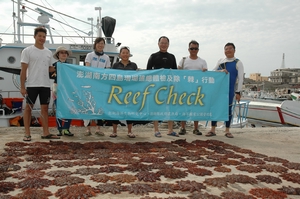
In order to assess the condition of coral reef ecosystems in the Penghu South Four Islands and remove coral-threatening crown-of-thorns starfish, the Marine National Park Headquarters, together with the Penghu Marine Biology Research Center of the Fisheries Research Institute and the Penghu County Government Agriculture and Fisheries Bureau, conducted a three-day coral reef survey and crown-of-thorns starfish removal operation from June 17 to 19, 2013. Results from eight survey transects showed an average live coral cover of 50.6%. Giant triton shells exceeding 30 cm in size were also recorded, indicating that the coral reefs remain in relatively healthy condition. A total of 191 crown-of-thorns starfish were removed. Among them, 181 individuals were collected from coral reef areas southeast of Xiji Islet, with an average body length of 31.3 cm. Ten individuals were removed from Xiyuping Islet, averaging 35.1 cm in length. No crown-of-thorns starfish were found in the waters around Dongyuping Islet or Tiezheng Islet.
The marine environment of the Penghu South Four Islands is influenced by interactions between complex seabed topography and branches of the Kuroshio Current, creating upwelling phenomena that support rich marine biodiversity. In recent years, the Penghu waters have experienced several cold-water events. To better understand the health of coral reef ecosystems in the region, the Marine National Park Headquarters and partner agencies conduct annual “Coral Reef Check” surveys to continuously monitor reef conditions. These efforts are complemented by the “Thorn Strike Action,” which focuses on removing coral-damaging crown-of-thorns starfish.
The crown-of-thorns removal campaign in the waters around Xiji Islet has now been carried out for three consecutive years. Removal totals in previous years were 100 individuals (2011) and 143 individuals (2012). In earlier years, removal operations were not conducted during the species’ breeding season, and the starfish were evenly distributed across the reefs. This year, however, underwater removal was deliberately scheduled just prior to the reproductive season. Dissections revealed that each removed starfish possessed well-developed, mature gonads. The population also exhibited aggregated distribution patterns due to breeding congregations, with mating behavior already observed. As a result, this year’s removal reached a record high of 181 individuals in the Xiji area, effectively helping to curb further population expansion. In the future, the Marine National Park Headquarters and the Penghu Marine Biology Research Center of the Fisheries Research Institute will continue long-term monitoring and investigations to safeguard the healthy coral reef ecosystems of the Penghu South Four Islands.
 |
 |
| “Thorn Strike Action” removed 191 crown-of-thorns starfish with significant results | Crown-of-thorns starfish aggregate during the breeding season |
 |
 |
| Removed starfish showing fully developed gonads | Survey personnel removing crown-of-thorns starfish |
 |
 |
| Survey personnel conducting a coral reef check | The giant triton is a natural predator of crown-of-thorns starfish |
Interpretation and Education Division