

At the end of May 2016, a protected humphead wrasse in Green Island was illegally poached by a local guesthouse operator. After the news broke, it sparked widespread public outrage. The loss of a single humphead wrasse was regrettable; however, this incident also demonstrated that public awareness of marine conservation has progressed significantly from past indifference. Such change is the result of sustained efforts by government agencies and various civil conservation groups, whose work has gradually fostered growth and awareness in society.
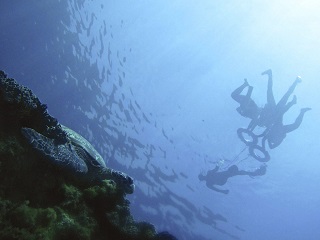
After gill nets were banned, sea turtles became a new highlight of Xiaoliuqiu (Photo by Sun Jie-heng).
The establishment of Dongsha Atoll National Park in 2007 marked a new milestone in Taiwan’s marine conservation, symbolizing the extension of national park resource protection from traditional terrestrial ecosystems to the broader marine environment. As the largest and only fully developed coral atoll in the northern South China Sea, Dongsha Atoll National Park bears a significant mission in natural resource conservation and management. Despite geographical limitations that pose management challenges, continuous efforts in research, long-term monitoring, habitat restoration, conservation patrols, beach cleanups, and biodiversity education have transformed this remote island park into an important hub for marine research and conservation in Taiwan. The long-term terrestrial and marine monitoring data accumulated by the Marine National Park Headquarters since its establishment provide valuable references for scientific research and environmental education.

Beach cleanup activity at Xiji Islet, Penghu.
In addition to management by dedicated government agencies, spontaneous marine conservation actions by local communities are equally inspiring. In 2013, Xiaoliuqiu voluntarily promoted a ban on gill nets within three nautical miles of its coastline. This initiative not only fostered a more marine-friendly environment but also supported Pingtung County Government’s regulation prohibiting all gill net fishing gear from entering or leaving Liuqiu’s fishing ports. Within two years, positive results became evident: sea turtles returned to Xiaoliuqiu, attracting tourists eager to see them and increasing local income through ecotourism. Today, coastal communities are increasingly aware of the importance of marine conservation. Voluntary actions such as limiting destructive fishing practices, conducting patrols in protected areas, cleaning harbor waste, and developing ecotourism have given Taiwan’s oceans a much-needed opportunity to recover.
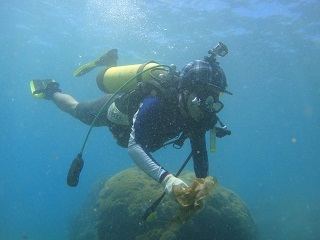
Conservation personnel removing marine debris at Wanlitong (Photo provided by Lin Yu-kai).
While both government and civil society have actively promoted various marine conservation efforts, consumers also play a vital role in protecting the ocean. By choosing seafood that meets the principles of “green seafood” and sustainability, and by refusing to purchase or consume overfished species or seafood caught or farmed using methods that severely harm ecosystems, we can support marine conservation in action and promote the concept that “no buying means no killing.” Additionally, reducing the use of plastic bags and changing disposable habits can make a significant difference. If each person reduces just one piece of plastic waste per day, Taiwan’s total waste output would decrease considerably. Continuous waste reduction directly lowers harm to terrestrial and marine organisms and the environment. Rather than merely lamenting the possibility of a future without fish to eat, we should begin with our daily choices and consumption behaviors to practice ocean-friendly actions. By recognizing that individual actions can influence marine ecosystem health, hope for a sustainable ocean begins with each of us.
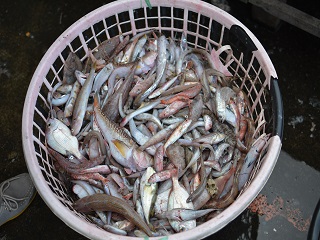
Bottom trawling indiscriminately captures marine life, leaving devastation in its wake. Consumers should choose seafood from sustainable fishing methods (Photo provided by Lin Yu-kai).