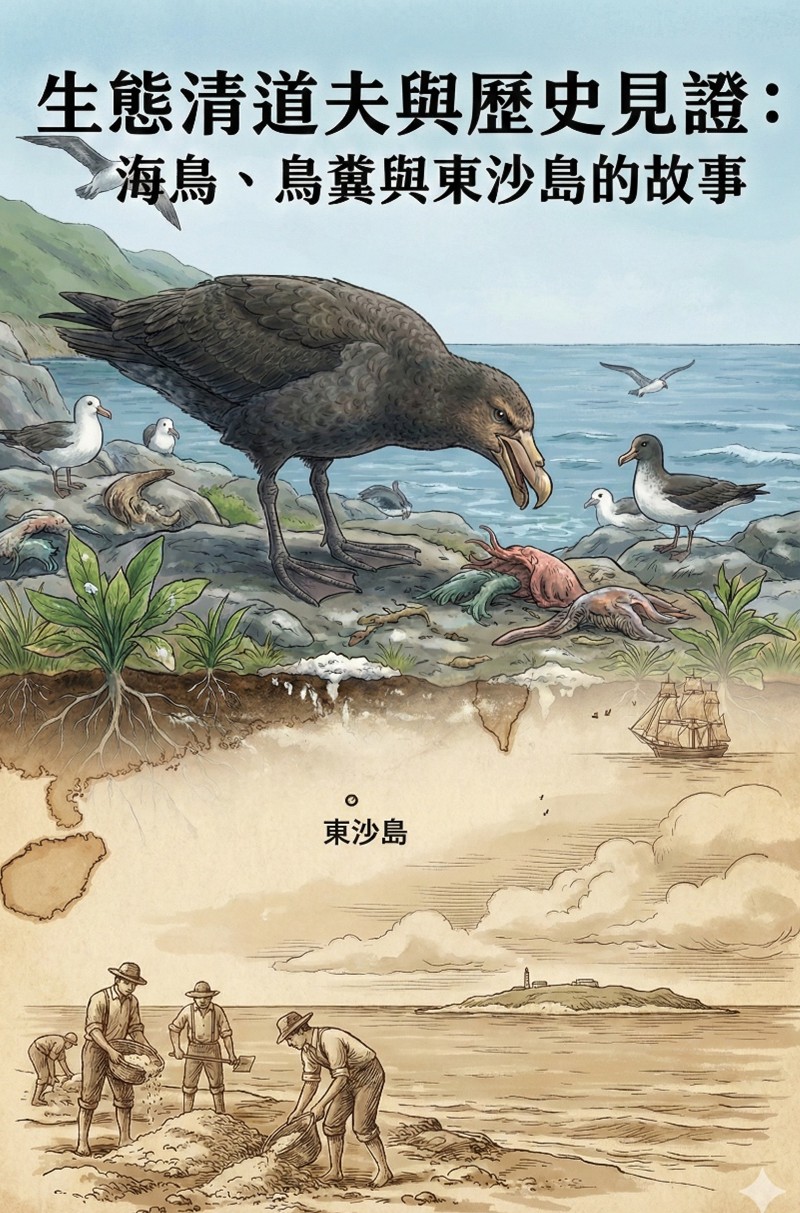

In marine ecosystems, seabirds are often seen as symbols of grace, yet they also serve as essential “sanitation workers” of the natural world. The giant petrel, for example, feeds on dead penguins, seals, and fish, rapidly removing decaying carcasses and reducing the spread of pathogens. These behaviors may appear gruesome, but they are indispensable to ecological balance. Without them, many coastlines would be piled with rotting organic matter, and the entire energy cycle of the system would be disrupted.
More importantly, seabirds do more than clean the ocean. They transport nutrients back to islands. After consuming nitrogen- and phosphorus-rich food at sea, they deposit those nutrients onto island soils in the form of guano. For resource-poor islands, guano becomes a vital fertilizer that sustains plant growth and supports the broader ecological community. Surprisingly, however, guano has influenced not only ecology but also world history. The example closest to Taiwan is none other than Dongsha Island.
Today, Dongsha Island lies within Taiwan’s Dongsha Atoll National Park and is a focal point of marine conservation. But in the early 20th century, it was more like a treasure island, which is a coveted site where nations competed to extract the “white gold” of guano. Rich in nitrogen, phosphorus, and potassium, guano was once the world’s most important natural fertilizer, so valuable that it sparked wars. South America famously experienced the “War of the Pacific,” was a war between Chile and a Bolivian–Peruvian alliance from 1879 to 1884, in which competition over guano and nitrate resources even cost Bolivia its coastline.
This global guano rush eventually swept into the South China Sea. According to later-declassified CIA documents and studies by Taiwanese scholars, Japan began large-scale guano extraction on Dongsha Island in 1907. The enterprise was led by Japanese entrepreneur Nishizawa Kichiji, who even nicknamed the island “Nishizawa Island” and recruited laborers from Ryukyu and Taiwan. Within just a few years, roughly ten thousand tons of guano were transported to Japan as a major agricultural resource.
The scale of extraction drew the attention of the Qing dynasty. In 1909, the Qing administration pressured Japan and dispatched officials to investigate, ultimately forcing Japan to abandon the operation. Dongsha Island was subsequently placed under the jurisdiction of Guangdong Province. In other words, guano indirectly contributed to the formalization of Dongsha’s sovereignty. Although rarely mentioned today, this episode significantly shaped the political landscape of the South China Sea.
While guano benefits ecosystems, it also creates new problems in the modern environmental context. As seabirds forage, they accumulate pollutants from the ocean, such as heavy metals and pesticides, and these contaminants become concentrated on islands through guano deposition, creating localized pollution hotspots. Moreover, because guano enriches island vegetation, it unintentionally provides abundant food for introduced mammals like pigs and rats, whose populations can explode and further threaten native species. Thus, guano is neither simply “good” nor “bad”; instead, it sits at the center of a complex web influenced by climate change, human activity, and invasive species.
That something as unassuming as guano could shape the fate of islands is remarkable. And seabirds circling above the waves are not merely creatures of the sky, but key actors connecting ocean and land, ecology and history. The next time you see a seabird, remember it is not just a shadow in the sky, but one of the oldest messengers and witnesses of the relationship between the sea and the islands it sustains.