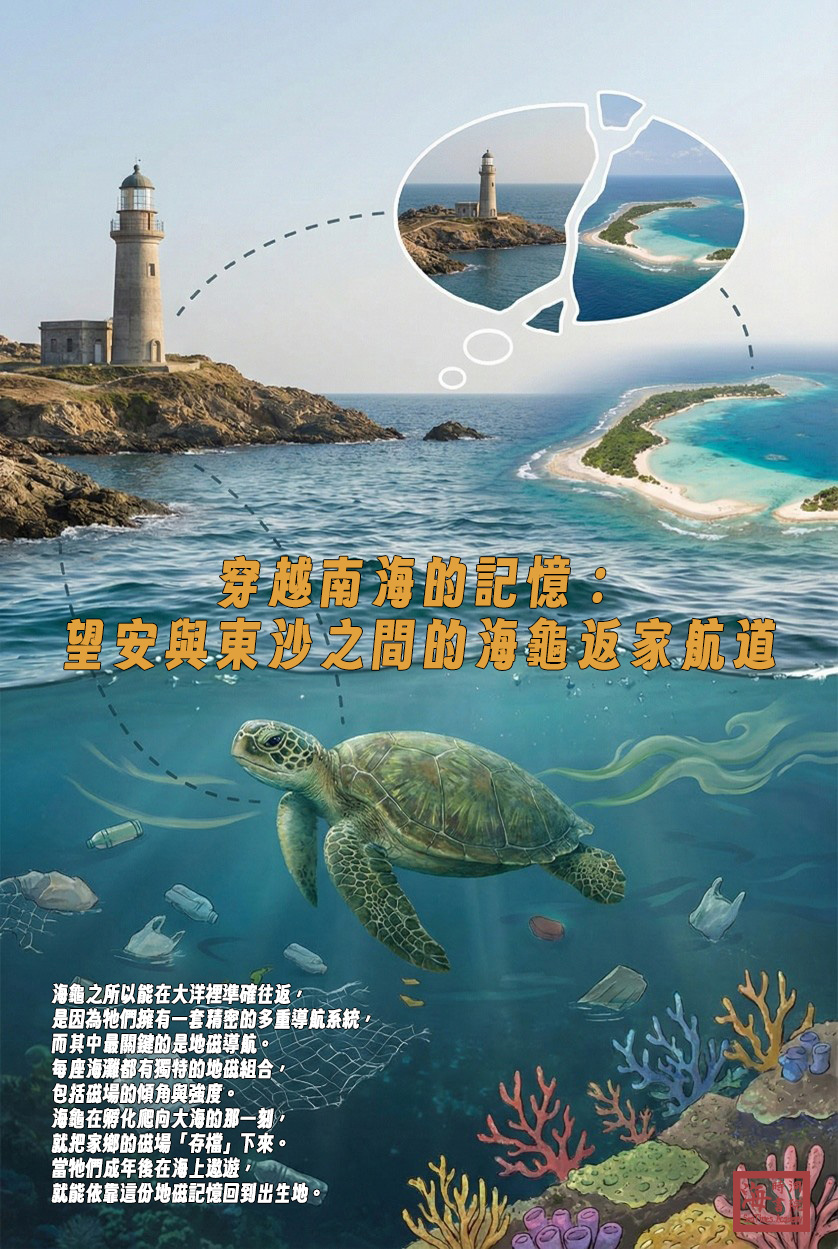


Among Taiwan's outlying islands, Wang-an and Dongsha (the Pratas Islands) appear distant and unrelated. Yet, for sea turtles, these two locations serve as the dual coordinates of "home" and their "living sphere." The recent news coverage of the sea turtle "Wang-an 139" is the perfect example. Over the past 28 years, she has returned to nest in Wang-an, Penghu, on a fixed schedule every two to three years. Tracking research reveals that her regular habitat lies far away in the distant Dongsha Atoll. This journey across the South China Sea is not only magnificent but also connects an invisible ecological link between Wang-an and Dongsha.
The reason sea turtles can navigate the open ocean with such precision is their sophisticated multi-sensory navigation system, with geomagnetic navigation being the most critical component. Every beach possesses a unique geomagnetic combination, including the inclination and intensity of the magnetic field. The moment a hatchling crawls toward the sea, it "archives" the magnetic signature of its birthplace. When roaming the ocean as adults, they rely on this geomagnetic memory to return to their place of birth. This explains why Wang-an 139, despite living in Dongsha, can still accurately return to the exact same beach in Wang-an during breeding season.
However, geomagnetism only guides the turtles to the general vicinity. Once they arrive in the waters near their birthplace, their navigation system switches to "olfactory mode." Every island emits unique "odor plumes," which are chemical signals derived from local vegetation, soil, and coastal microbes. Sea turtles follow these faint scents like travelers chasing the smell of a home-cooked meal; the closer they get to home, the more familiar the scent becomes, guiding them through the dark to their nesting beaches with precision.
The status of Wang-an and Dongsha as a vital living circle for foraging and returning home is deeply tied to their environmental conditions. The Dongsha Atoll, with its vast coral reefs, seagrass beds, and highly productive waters, serves as an excellent foraging ground for green sea turtles. There, they accumulate energy before returning to Wang-an to spawn years later. Wang-an, in turn, provides fine sandy beaches and coastal temperatures ideal for incubation, making it an irreplaceable nesting ground. Dongsha is their base for living, while Wang-an is the starting point of their lives and the place where their lineage continues. Together, these two locations form a dual-core ecological corridor for green sea turtles.
Regrettably, human activity is causing this trans-oceanic corridor to fade. Maritime noise interferes with the turtles' hearing; coastal light pollution disorients hatchlings; and the magnetic fields from submarine cables may even distort their geomagnetic maps. Even more dangerous is the plastic debris floating at sea. After drifting in the ocean for a long time, plastic waste becomes coated with marine organisms, forming a biofilm. This biofilm emits an odor similar to food, becoming an olfactory trap that misleads turtles. This "sensory pollution" makes the journey home increasingly difficult and fills their migratory life circle with risk.
Therefore, sea turtle conservation is no longer a problem solved solely by guarding beaches; it requires protecting the entire life corridor spanning thousands of miles. From light-pollution-free coastal management to marine debris removal, and from reducing ocean noise to avoiding engineering that disrupts magnetic fields. Those all are key to ensuring sea turtles can safely travel the seas.
The migratory journey between Wang-an and Dongsha is, for the sea turtle, a lifeline woven from magnetism, scent, and memory. Every turtle that returns to Wang-an tells us that the ocean knows no borders, and the journey of life cannot be limited by maps. To protect the sea turtle is to guard this ancient maritime passage that crosses the ocean and connects these two islands.