

When we talk about the Dongsha Atoll, most people think of beautiful coral reefs and the pristine white beaches of Dongsha Island. However, a crucial part of this healthy marine ecosystem lies below the surface: the quietly swaying seagrass meadows. As we've mentioned before, the carbon sequestration ability and overall health of these seagrass meadows are key to fighting climate change. With the growing urgency of climate change, the spotlight is increasingly on seagrass meadows as a "blue carbon" reservoir. Let's take a closer look at the Dongsha Atoll's seagrass meadows to gain a more complete understanding of this important issue.
The inner lagoon of the Dongsha Atoll provides an excellent environment for seagrass growth, with approximately 7,000 hectares of seagrass distributed throughout the atoll. A recent study by Associate Professor Tzu-Hsuan Tu of National Sun Yat-sen University found that the organic matter content in the surface sediments beneath the Dongsha seagrass beds ranges from 1% to 10%. This value is influenced by environmental and biological factors like water currents, depth, and seagrass species. This organic matter is the widely discussed blue carbon reservoir, where atmospheric carbon is converted into organic matter through photosynthesis and sequestered on the seafloor, slowing the accumulation of greenhouse gases.
However, accurately calculating the carbon contribution of seagrass meadows is not easy. One challenge is that a large amount of the biomass from the Dongsha seagrass is exported out of the system. We often see piles of seagrass washed ashore on Dongsha Island's beaches, which is a physical representation of the seagrass ecosystem exporting carbon. While it is very difficult to calculate this portion of the biomass, it is a key factor for accurately assessing the blue carbon contribution of the Dongsha seagrass meadows in the future.
Additionally, simply looking at the area of a seagrass meadow is not enough to evaluate its carbon storage capacity; seagrass density also plays a crucial role. For the same area, a dense, flourishing seagrass meadow has a much higher carbon storage capacity than a sparse one. It's even more concerning that if a seagrass meadow's density decreases and it begins to deteriorate due to environmental changes, it could reach a tipping point and transform from a carbon sink into a carbon source. It may even begin to release methane, a greenhouse gas more potent than carbon dioxide, which would have a more severe impact on the global climate.
Therefore, continued research and monitoring of the health of seagrass meadows are extremely important for developing comprehensive climate response strategies in this "era of carbon."
In the face of these challenges, the Marine National Park Headquarters is actively collaborating with academic institutions. Our goal is to develop seagrass restoration techniques and conduct research on the conservation and restoration of the Dongsha seagrass ecosystem from a holistic perspective. This will provide scientific support for future seagrass conservation and restoration policies and actions. The seagrass meadows of the Dongsha Atoll are an indispensable part of overall ocean health. They are not only a vital ecosystem but also our natural ally in the fight against climate change.
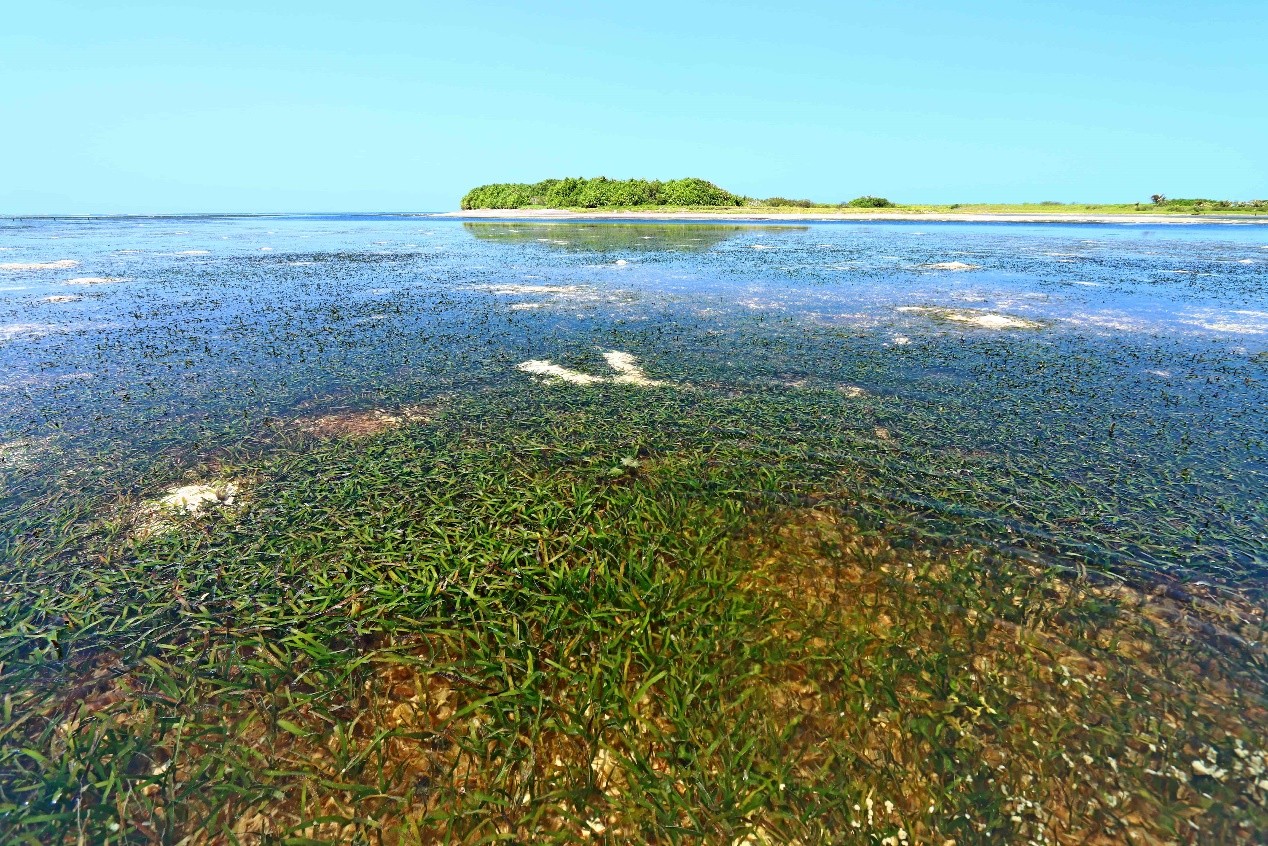
Dongsha Atoll's Seagrass