

Sea turtles are ancient and silent travelers of the ocean. They have existed since the age of dinosaurs, enduring ice ages and dramatic shifts between land and sea. Yet today, they face unprecedented threats in the human era. The waters around Taiwan are fortunate to host five of the world’s seven sea turtle species, including Green turtles, Loggerheads, Olive ridleys, Leatherbacks, and Hawksbills. Among them, the green turtle is the species most closely connected to Taiwan. They not only forage in nearby waters but also nest on Taiwan and its surrounding islands. In recent years, tracking studies have revealed that Dongsha Atoll National Park plays a crucial role in the life cycle of these turtles.
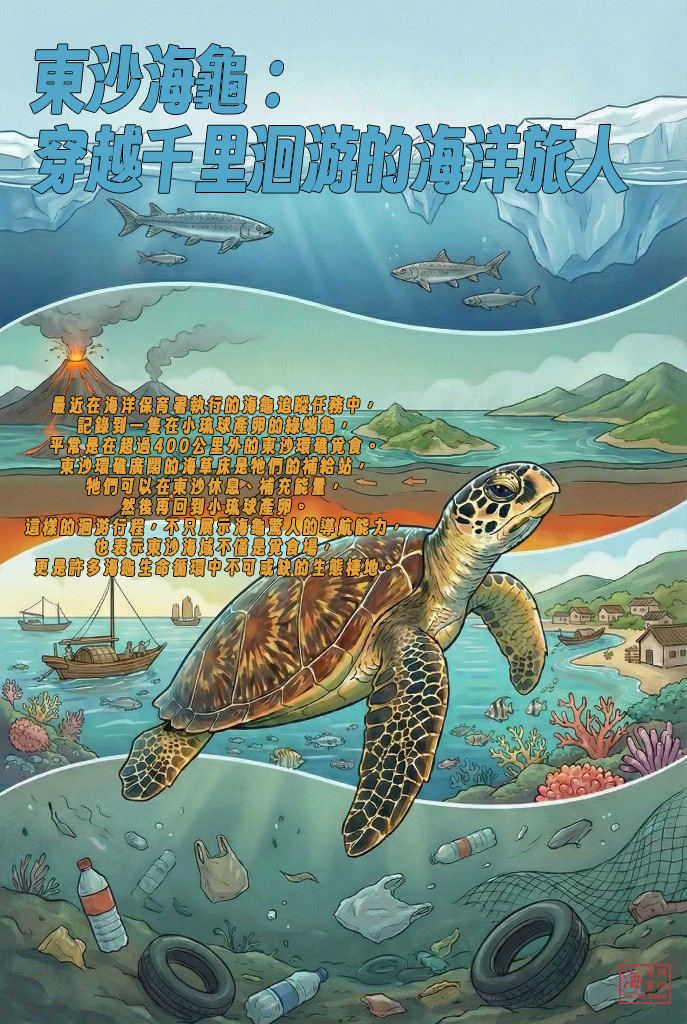
During a recent tracking project conducted by Taiwan’s Ocean Conservation Administration, researchers documented a green turtle that nests in Xiaoliuqiu but regularly travels over 400 kilometers to forage at Dongsha Atoll. The vast seagrass beds around Dongsha Atoll serve as feeding grounds, allowing turtles to rest and refuel before returning to Xiaoliuqiu to nest. This long-distance migration showcases the turtles’ astonishing navigational abilities and highlights Dongsha Atoll as not only a foraging site but also an essential ecological habitat in the life cycle of many sea turtles.
A sea turtle’s life generally consists of two major phases: foraging and reproduction. Green turtles feed primarily on seagrass, and healthy seagrass beds help maintain water quality, stabilize sediments, and provide habitat for numerous marine species. In other words, protecting sea turtles means protecting the foundation of the marine ecosystem, particularly the extensive and ecologically rich seagrass meadows found in Dongsha, the largest in Taiwan’s surrounding waters.
On the reproductive side, Taiwan’s most important nesting sites are the beaches of Wang’an in Penghu and several sandy beaches in southern Taiwan. Female turtles typically return to their birthplace to nest every three to five years, laying around four clutches each time, with about one hundred eggs per clutch. Although this sounds like a lot, fewer than one in a thousand hatchlings survive predation and human-caused threats to reach adulthood. With climate change intensifying, rising temperatures are also quietly altering sea turtle sex ratios. Because sea turtle sex is determined by incubation temperature, studies show that just a 1°C increase in nest temperature can result in up to 80% female hatchlings. As males become increasingly rare, the reproductive stability of turtle populations will face severe challenges.
Beyond warming oceans, sea turtles confront plastic pollution, light pollution, entanglement in fishing gear, and shrinking habitats. Plastic bags resemble jellyfish, making leatherbacks, whose primary prey is jellyfish, particularly vulnerable to ingestion. Fishing gear entanglement has caused many turtles to drown or become injured, making it one of the leading human-related causes of sea turtle deaths worldwide.
Despite these threats, there is much we can do. First, we must protect nesting and foraging habitats. The establishment of Dongsha Atoll National Park is already an important step for sea turtle conservation. Second, we can promote eco-friendly tourism and sustainable fishing practices, such as reducing light pollution, installing Turtle Excluder Devices (TEDs) on fishing gear, and implementing seasonal beach restrictions. Most importantly, continued scientific monitoring and public participation are essential to sharing the turtles’ stories and safeguarding their future.
Dongsha’s seagrass beds, Taiwan’s beaches, and the ocean currents connecting them weave together the map of a sea turtle’s life. These ancient travelers are markers of a changing planet. If we choose to use fewer single-use plastics, be mindful of beach lighting, and support ocean-friendly policies, these creatures, who have survived for millions of years, may continue navigating our oceans for millennia to come.