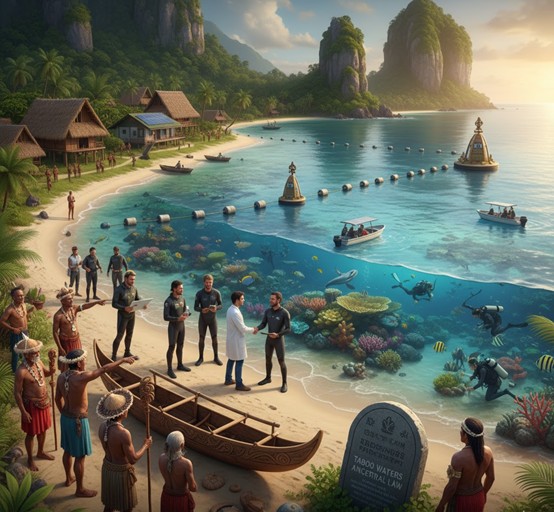


In the field of contemporary marine conservation, a new trend rooted in ancient wisdom is leading us to rethink the relationship between humans and the ocean. It not only reminds us of the need for reverence toward nature but also provides a practical and feasible path toward achieving global biodiversity targets. This involves integrating Indigenous and local communities’ traditional ecological knowledge (TEK) into the planning and management of modern Marine Protected Areas (MPAs) and Other Effective Area-based Conservation Measures (OECMs).
Human attitudes toward the ocean have shifted from traditional reverence to industrialized, exploitative fishing practices. Driven by the pursuit of unlimited catches while ignoring ecological limits, about one-third of global fishery resources now face the threat of overfishing. In response, over the past two decades, the international community has continuously promoted the designation of MPAs by governments worldwide. Yet, both the 2010 Biodiversity Targets and the Aichi Targets failed when it came to global MPA coverage. Taiwan, in line with international trends, established Dongsha Atoll National Park in 2007 and the South Penghu Marine National Park in 2014. Together with other national parks that include marine areas, such as Kenting and Taijiang, Taiwan’s marine protected area in the national parks cover 4,394.95 square kilometers, accounting for about 81% of the total area of the nation’s marine protected zones.
Globally, MPAs currently cover only about 9.61% of the ocean’s surface, a proportion clearly lagging behind the urgent need to safeguard marine biodiversity. In 2022, the Kunming-Montreal Global Biodiversity Framework set a more ambitious target: protecting at least 30% of the world’s oceans by 2030 (the “30x30” goal). To meet this target, OECMs are increasingly included in the calculation, recognizing not only legally designated protected areas but also other geographically defined areas that can effectively contribute to in-situ biodiversity conservation. This international consensus elevates TEK to a central role, urging nations to learn from Indigenous peoples and local communities who have coexisted with the ocean for generations, and to integrate their knowledge, innovations, and sustainable practices. The protection offered by Indigenous marine territories, customs, and regulations is exactly what should be rediscovered and formally recognized.
Such culturally grounded conservation practices are especially visible in Pacific Island nations. For example, in Fiji, Indigenous communities call their traditional fishing grounds Qoliqoli and manage them through rotational access decided by village chiefs. More importantly, they establish Tabu areas as temporary or permanent no-take zones. In some cases, funerary protected areas are declared after the death of a chief, designating parts of the sea as Tabu for 100 nights, during which all resource extraction is prohibited. These taboos, reinforced by beliefs in “supernatural punishment,” can exert stronger and more internalized constraints than modern fines, which are often difficult to enforce. Thereby ensuring sustainability more effectively. Many of these Indigenous or community-managed fishing grounds, though not labeled as conservation areas, deliver real ecological benefits and align closely with OECM criteria.
In conclusion, recognizing ancient taboos, myths, and local wisdom as potential forms of OECMs can not only expand marine conservation coverage but, more importantly, bring into the conservation system the “intrinsic moral obligations” and “localized, effective management practices” that modern laws often fail to instill. Through the mechanism of OECMs, we can integrate traditional wisdom and work toward a more humble and sustainable vision of coexistence between humanity and the ocean.