

On the western side of the vast Pacific Ocean, there is a significant warm current that flows northward from the Philippine Sea, passes along the eastern coast of Taiwan, and then winds its way past the Japan. This powerful, deep-blue ocean current is the Kuroshio Current.
Its name, which translates to "Black Current" in Japanese, comes from its deep, dark color. Because of its swift speed, high temperature, and high salinity, the Kuroshio has relatively few plankton and suspended particles. This makes it difficult for sunlight to penetrate, so when viewed from above, it appears as a beautiful, deep indigo blue, like a giant black dragon surging through the sea.
The Kuroshio is not an isolated phenomenon; it's a crucial part of the global ocean circulation system. It originates from the North Equatorial Current, which splits into two branches upon hitting the Philippine islands. One branch flows south, becoming the Mindanao Current, while the other powerful branch turns north. Here is the starting point of the Kuroshio.
This warm current travels northward along the eastern coast of Taiwan at speeds of up to 1 meter per second. It forms a distinct main stream east of Taiwan before continuing north past the Ryukyu Islands and southern Japan. Eventually, it merges with the North Pacific Current, flowing eastward across the Pacific to the west coast of North America, where it becomes an important factor influencing the climate of that region.
For Taiwan, this warm current brings a significant amount of heat to the eastern waters, keeping the surrounding ocean temperatures relatively high, even in winter. This creates an ideal habitat for a wide variety of marine life.
The Kuroshio also acts like an ecological conveyor belt, transporting rich biological resources from tropical waters to subtropical and temperate regions. Large quantities of plankton, fish eggs, juvenile fish, and even large migratory species like mahi-mahi and marlin travel with the current. These migratory fish are not only a major fishing resource for eastern Taiwan but also sustain the livelihoods and culture of local fishermen.
Beyond fisheries, the Kuroshio nurtures the rich coral reef ecosystems along Taiwan's eastern coast. Stable, warm temperatures are a critical condition for coral reef growth. Areas like Orchid Island, Green Island, and Kenting boast well-developed coral reefs and are popular destinations for divers.
The Kuroshio is more than just a cradle of marine ecosystems; it's a regional climate regulator. It transfers heat from the tropics to higher latitudes, significantly impacting the climate of both Taiwan and Japan. The warm waters of the Kuroshio not only bring moisture but also provide heat to typhoons that pass through, making the current's dynamics an important factor in weather forecasting.
However, in recent years, climate change has posed a potential threat to the Kuroshio. Rising sea temperatures and ocean acidification could alter its speed, path, and temperature. This would, in turn, affect the ecosystems and climate patterns it supports. Therefore, deeper research and monitoring of the Kuroshio's changes are crucial to understanding how they will impact Taiwan, Japan, and the entire North Pacific region.
Ultimately, the Kuroshio provides us with more than just abundant fishery resources and beautiful marine landscapes. It also plays a key role in regulating our climate. Through scientific research and ecological conservation, we can gain a deeper understanding of the life it brings to our shores and work to sustain its vitality.
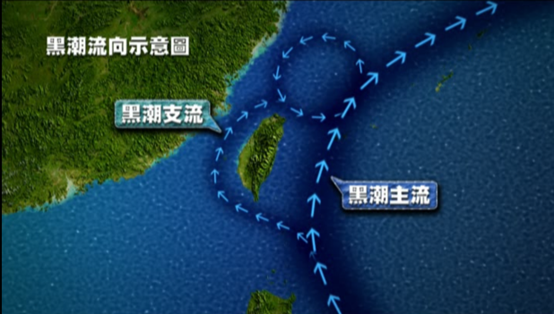
“A Dialog Between Kuroshio and the Islands” The Kuroshio Current